
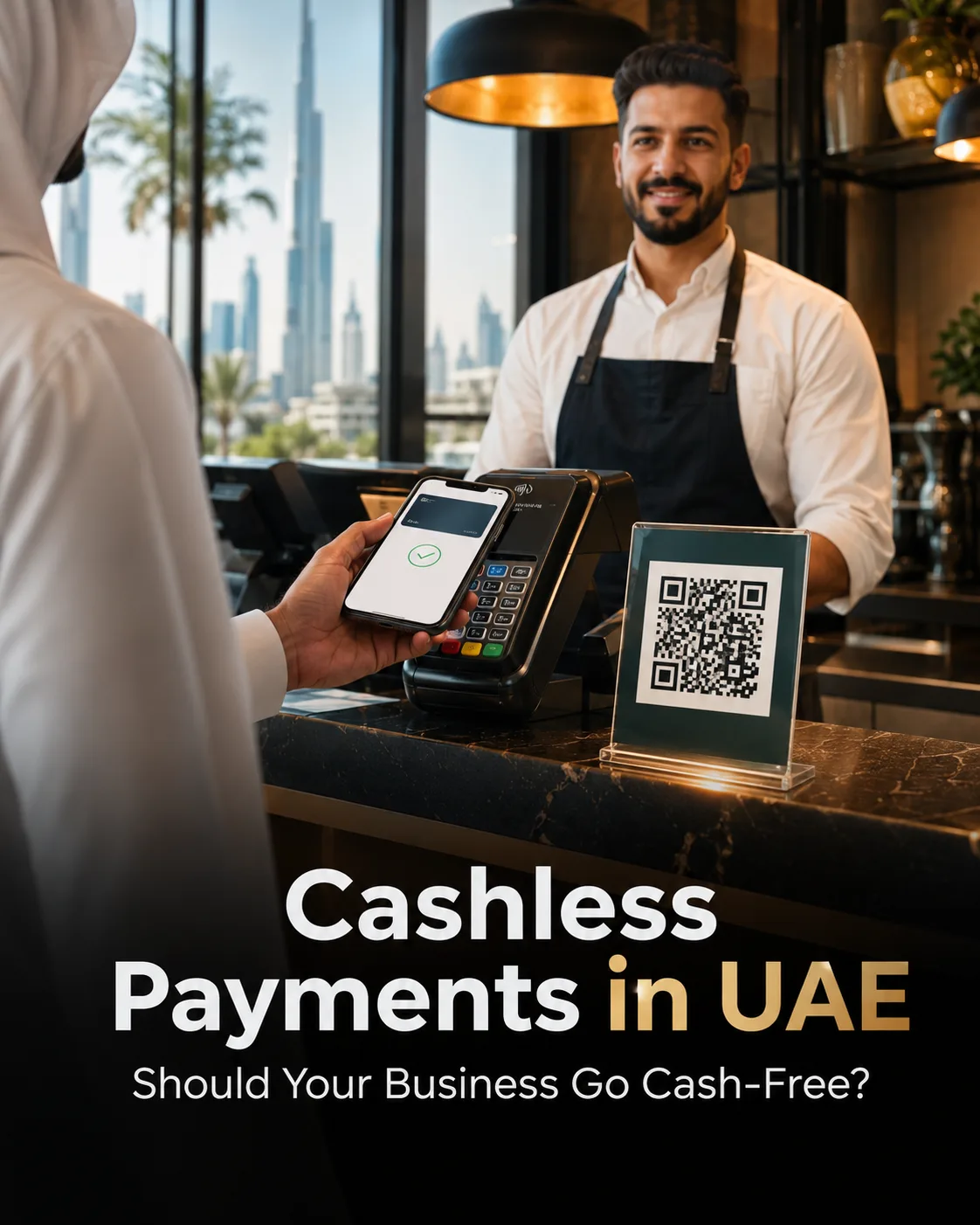
Pull out your wallet in a Dubai cafe and there is a good chance you will not need the notes inside it. Cards, phones, watches and QR codes now handle a large share of everyday payments in the UAE.
For businesses, that raises a practical question: if most customers already prefer digital payments, does accepting cash still make sense?
The UAE is certainly moving in that direction. Visa's 2026 consumer research found that 80% of surveyed payments in the UAE were digital. Around 68% of consumers described themselves as largely non-cash users while cash accounted for only 16% of everyday purchases among respondents.
Dubai is pushing the shift further through its Dubai Cashless Strategy, which targets 90% cashless transactions across government and private sectors by the end of 2026. The strategy is expected to contribute more than AED 8 billion annually to Dubai's economy through digital commerce and financial technology.
Going digital makes sense for many companies. Going completely cash-free needs a little more thought.
How Cashless Is the UAE in 2026?
It is quite cashless already. The trend is visible in shops, restaurants, taxis, hotels and online businesses. Mobile payments alone accounted for around 21% of surveyed UAE transactions in Visa's 2026 research. The country's payment infrastructure is also getting broader.
Al Etihad Payments reported in April 2026 that Aani had more than 12.5 million registered users connected through 74 licensed financial institutions. The platform supports instant transfers, QR payments and requests for payment. Transfers can be completed within seconds.
Jaywan, the UAE's domestic card scheme, is another important development. Nationwide card issuance began in July 2026 and the system is designed partly to reduce electronic payment costs for local merchants.
What Does Going Cash-Free Actually Mean?
A cash-free business stops accepting physical notes and coins.
Customers may instead pay through:
Debit and credit cards
Apple Pay, Google Pay or Samsung Wallet
Aani or QR payments
Payment links
Online payment gateways
Bank transfers
Jaywan cards
Approved instalment or BNPL services
You do not need to remove cash to benefit from these systems. A business can operate as digital-first, where electronic payment is encouraged while cash remains available when needed.
That distinction is important.
In a 30-minute call we map your situation against jurisdiction, activity and cost — no commitment required.
Benefits of Cashless Payments for UAE Businesses
- Faster Checkout
Tap-to-pay transactions can take seconds.
That can make a noticeable difference in cafés, restaurants, supermarkets and other businesses handling hundreds of customers each day.
Less time dealing with change also means shorter queues.
- Easier Accounting and Reconciliation
Cash creates physical work. Someone has to count it, maintain a till float, investigate shortages, prepare deposits and match daily sales against the register.
Digital transactions already create an electronic trail. When your POS, bank account and accounting software work together, daily reconciliation becomes much easier.
Having the right UAE business bank account is therefore one of the first things to sort out before increasing digital collections.
- Lower Cash-Handling Risk
Physical cash can be lost, miscounted or stolen.
Reducing the amount held on the premises can lower these risks, especially for restaurants, retail shops and businesses operating late at night.
It can also reduce trips to deposit cash at a bank.
- Better Options for Online Businesses
For an e-commerce company, digital payment acceptance is essential.
Cards, wallets and payment links let customers complete purchases immediately rather than arranging bank transfers or cash on delivery.
If you are building an online store, Nexture's guide to an e-commerce licence in Dubai explains the wider licensing requirements.
- Customers Increasingly Expect It
Payment choice now affects customer experience.
A 2026 UAE survey of 1,050 residents found that 70.7% said they had become more willing to use digital wallets instead of cash or physical cards.
A business that accepts only cash may therefore create more friction than one encouraging digital payment.
What Are the Downsides of Going Completely Cash-Free?
The benefits are strong, but digital payments are not free or riskless.
Payment Processing Costs
Card acquiring normally involves commercial charges.
Depending on your provider and transaction type, you may encounter:
Merchant discount rates
POS terminal rental
Payment gateway fees
International card charges
Currency conversion costs
Refund fees
Chargeback costs
Do not choose a provider based only on the advertised transaction rate.
Ask for the complete fee schedule and calculate what you would actually pay based on your monthly sales volume and average order value.
Payment Outages
Internet connections fail. POS terminals occasionally stop working. Payment gateways can have technical problems.
If you remove cash completely, a payment outage can stop sales.
Keep a backup connection and preferably more than one digital collection method. For example, you might use a POS terminal plus Aani or payment links.
Fraud and Chargebacks
Cash cannot generate an online chargeback. Cards can.
E-commerce businesses in particular need strong checkout security, refund procedures and transaction monitoring.
The PCI Security Standards Council's PCI DSS requirements apply to organisations that store, process or transmit payment-card information. Even businesses outsourcing card processing retain responsibilities for choosing compliant providers.
Some Customers Still Want Cash
Digital adoption is high, but cash has not disappeared.
Tourists, older customers, people without suitable cards and customers facing phone or banking problems may still prefer it.
Removing this payment option can mean losing a perfectly good sale.
Should Your UAE Business Go Fully Cash-Free?
It depends on who pays you.
Business Type | Practical Approach |
E-commerce store | Fully digital usually makes sense |
SaaS or online service | Digital payments are normally enough |
Office-based consultancy | Digital-first is practical |
Cafe or restaurant | Digital-first with cash backup |
Retail store | Accept digital payments and consider retaining cash |
Hotel or tourism business | Offer several payment methods |
Small market trader | QR payments can help but cash may remain useful |
An online company registered through an E-Trader licence in Dubai may rarely need physical cash. A neighbourhood grocery store serving a much broader customer mix faces a different situation.
Your customer data should make the decision.
How to Move Your Business Towards Cashless Payments
Start gradually.
First, review your current transactions. Check what percentage of sales already come through cards, wallets, bank transfers and cash.
If 95% of customers already pay digitally, reducing your dependence on cash will be easier than if cash still represents 40% of sales.
Second, establish reliable banking. Banks carry out detailed KYC checks, so prepare the right documents early. If you have already faced problems, see the guide to corporate bank account rejection in the UAE.
Third, compare payment providers. Look at settlement periods, transaction fees, refund procedures, chargebacks, POS costs, wallet support and technical support.
Payment providers themselves operate within the CBUAE regulatory framework. The CBUAE Retail Payment Services and Card Schemes Regulation covers regulated payment activities including merchant acquiring, payment aggregation and payment initiation services.
Finally, keep a backup. One POS terminal should not be your entire payment infrastructure.
A second connection, QR payment option or payment link can keep transactions moving when one channel fails.
We’ll model the requirements and send back a single-page breakdown within 24 hours.
Can a Business in the UAE Refuse Cash?
There is an important legal point here.
Under Article 54 of the current CBUAE law, UAE currency notes and CBUAE-issued currency in digital form are legal tender.
That provision should not be read by itself as a complete answer to every private merchant's payment policy. Sector rules, contractual requirements and consumer obligations may also apply.
If you plan to introduce a strict "no cash accepted" policy, check the requirements applying to your specific business and jurisdiction before doing so.
Conclusion
Cashless payments in the UAE are quickly becoming normal business infrastructure.
Customers increasingly expect cards, mobile wallets and QR payments. Aani and Jaywan are expanding local payment options while Dubai is actively targeting 90% cashless transactions by the end of 2026. Still, going digital does not automatically mean you should ban cash tomorrow.
For most physical businesses, the sensible approach is digital-first: make electronic payments fast and convenient, reduce your dependence on cash and keep a practical backup where your customer profile calls for it.
Once your own sales data shows that cash has become genuinely unnecessary, you can reassess.
Frequently Asked Questions
Is the UAE becoming a cashless country?
The UAE is moving strongly toward cashless payments, although cash is still in circulation. Dubai's Cashless Strategy aims for 90% of transactions across government and private sectors to be cashless by the end of 2026.
What are the most common cashless payment methods in the UAE?
Common options include debit cards, credit cards, Apple Pay, Google Pay, Samsung Wallet, payment gateways, payment links, QR payments, Aani, bank transfers and increasingly Jaywan.
What is Aani in the UAE?
Aani is the UAE's national instant payment platform operated by Al Etihad Payments. It supports payments using mobile numbers, email addresses and QR codes and operates 24/7.
Does accepting digital payments cost businesses money?
Usually, yes. Costs can include transaction charges, merchant acquiring fees, terminal fees and gateway charges. Pricing varies by provider, card type, turnover and payment channel, so businesses should compare full commercial terms rather than one advertised percentage.
Are cashless payments safer than cash?
They remove some risks associated with storing and handling physical cash, but they introduce digital risks such as fraud, compromised accounts, chargebacks and cyberattacks. Strong authentication, reliable providers and proper payment-security procedures are essential.
Should a small UAE business stop accepting cash?
Usually, there is no need to rush. If most customers already pay digitally, reduce cash handling gradually. Keeping cash as a backup can still be useful for physical businesses until customer behaviour clearly supports going fully cash-free.