
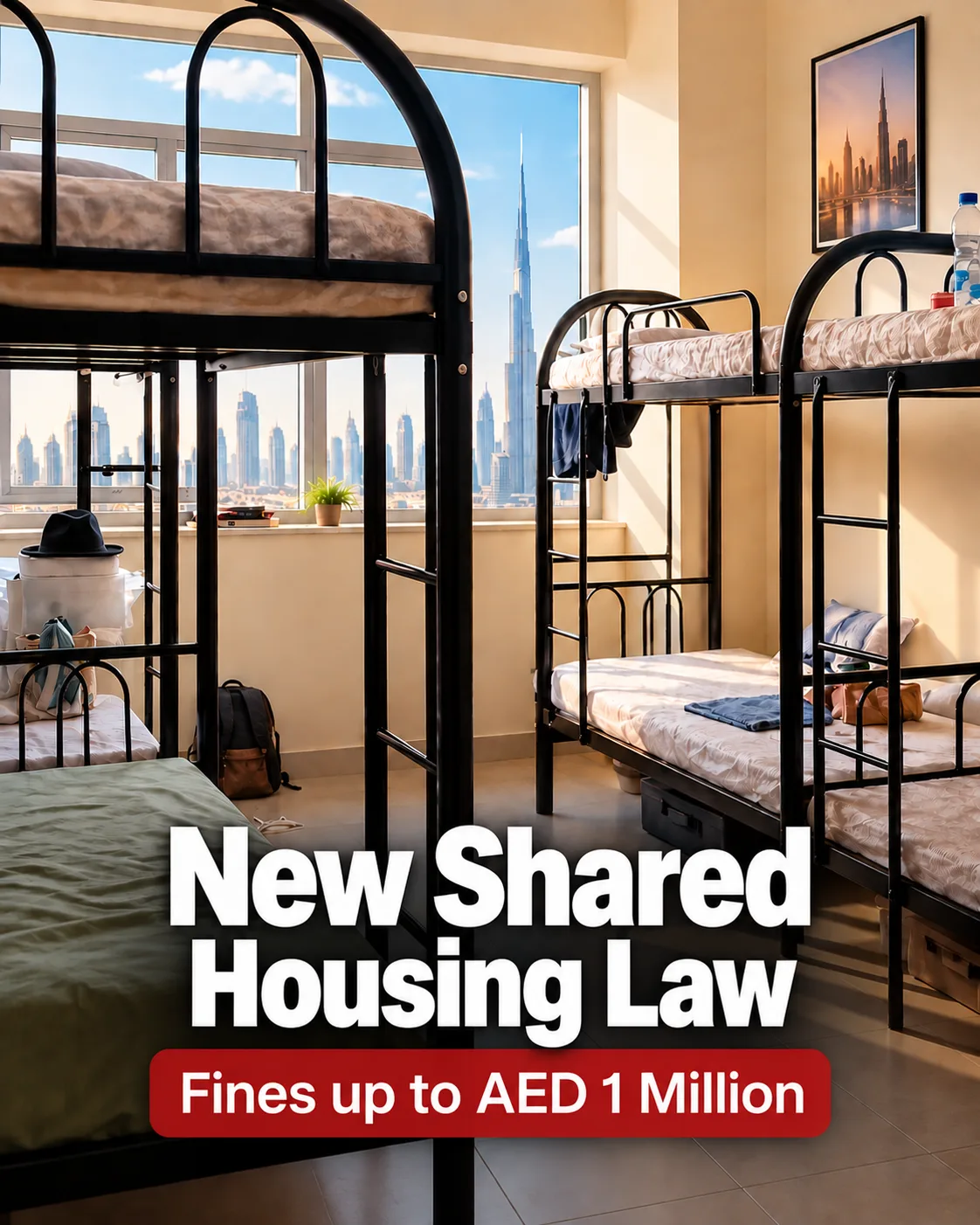
Sharing an apartment or villa has long been common in Dubai, especially among students, professionals and residents looking to reduce housing costs. In 2026, however, the rules around this type of accommodation changed considerably.
Officially known as Dubai Law No. (4) of 2026, the law introduces a new framework for regulating shared housing across the emirate. It creates a formal regulatory system for properties where individuals or families occupy separate spaces while sharing facilities such as kitchens, bathrooms or dining areas. The law does not ban shared accommodation. It regulates who can provide it, which properties can be used, how residents are contracted and what occupancy and safety standards must be followed.
The new law became effective on 26 August 2026. Existing owners and operators have one year to bring existing shared-housing arrangements into compliance, giving them a current regularisation deadline of 26 August 2027.
What Is Shared Housing Under Dubai Law?
Shared housing generally means accommodation where individuals or families are allocated separate spaces inside the same property while sharing common facilities or services.
The law can cover apartments, detached houses, residential complexes, mixed-use buildings, adjoining or townhouse-style properties and multi-storey buildings, provided they meet the required approvals.
It also recognises different resident categories, including families, individual men, individual women, male and female students and employees or workers in government and private organisations.
In a 30-minute call we map your situation against jurisdiction, activity and cost — no commitment required.
Is Shared Housing Legal in Dubai in 2026?
Yes. Shared housing remains legal in Dubai, but it now operates within a permit-based regulatory system. The law applies throughout Dubai, including private development areas, special development zones and free zones.
A property cannot simply be divided into rooms or bed spaces and rented to an unlimited number of people. The required shared-housing permit must be obtained and the approved occupancy and technical conditions must be followed.
Only the property owner or an authorised licensed establishment can lease regulated shared housing to residents. A resident cannot then rent their allocated space to someone else.
That change directly affects arrangements where a tenant rents an apartment and recovers part of the cost by charging other people for individual rooms or bed spaces.
Shared Housing Permits Are Now a Core Requirement
Dubai Municipality is responsible for regulating shared housing and overseeing the permit system. The permit determines how the property can be used, the relevant resident category and the permitted capacity.
A normal residential apartment does not automatically become suitable for large-scale sharing simply because it has enough floor area. Fire safety, sanitation, ventilation, electrical systems, property layout and other technical requirements also matter.
As of now, Law No. 4 itself does not state one universal rule such as four residents per one-bedroom apartment. Dubai Municipality has the authority to determine maximum occupancy, minimum space per person and communal facility requirements. Recent implementation reporting also confirms that property-specific limits depend on further technical rules and approvals.
So, if you see a fixed people-per-bedroom number online, do not assume it automatically applies to every Dubai property. Check the approved capacity for the property concerned.
Shared Housing Contracts Must Be Registered
Another major change is the creation of a formal Shared Housing Register through the Dubai Land Department framework. Regulated lease and management agreements must be registered. The landlord or operator must also provide the resident with a copy of the tenancy agreement.
This gives residents a stronger paper trail than paying cash each month to another tenant without any registered agreement.
The law also protects a resident acting in good faith where the landlord or operator fails to complete a registration they were legally required to make. The responsible party cannot simply rely on its own registration failure to avoid the resident's contractual rights.
Can Tenants Sublet Rooms or Bed Spaces?
This is one of the biggest practical changes under the Dubai shared housing law 2026. A resident in regulated shared housing cannot sublease the space allocated to them.
For example, suppose someone rents a two-bedroom apartment and then advertises one room or several bed spaces online for monthly payment. If the tenant is independently acting as the landlord to those residents, that arrangement can conflict with the new shared-housing framework.
This does not mean that every situation where friends or colleagues live together is automatically prohibited. The legal position depends on the tenancy structure and how the property is being used.
If separate residential spaces are being rented to different occupants, you should verify that the owner or authorised operator is providing the accommodation legally. If another tenant is asking you to pay rent directly to them, ask questions before moving in.
Occupancy, Partitions and Safety Rules
The new framework gives Dubai Municipality extensive authority over the physical condition of shared accommodation. Properties must meet applicable planning, building, public-health, fire-safety, sanitation, environmental, security and electrical standards. Landlords and operators also cannot make unauthorised structural changes or partitions.
This is particularly relevant to apartments where temporary walls have been added or where living rooms, kitchens and other areas have been converted into sleeping spaces.
Dubai Municipality already carried out inspections against overcrowding and illegal alterations before Law No. 4 became effective. The new transition period should therefore not be treated as permission to continue unsafe partitions or breaches of existing fire and building rules.
The law itself is also listed in Dubai Municipality's official building regulation and legislation directory.
What Rights Do Shared Housing Residents Have?
Residents receive several useful protections under the new framework.
Rent is determined by the tenancy agreement. Unless something different is agreed, it is payable monthly in advance.
Electricity and water are also treated as included in the rent by default unless the contract provides another arrangement.
A sale or transfer of ownership does not automatically cancel the resident's tenancy.
Residents can also terminate their agreement during its term in accordance with Article 20. The law refers to at least 30 days' notice, or a longer notice period where the contract requires one, and contains provisions dealing with prepaid-rent refunds.
Eviction also follows a legal procedure. An interested party can challenge an eviction decision within seven days under the process provided by the law.
What Must Landlords and Operators Do?
Owners and authorised operators now carry clear compliance responsibilities.
They must respect the approved occupancy level, register resident contracts, provide contract copies, maintain the property and avoid unauthorised alterations. Residents must also receive the applicable house rules and information explaining their rights and responsibilities.
Required identifying information must be displayed at the property, including details related to the permit and approved shared-housing category. Advertising is regulated as well. Printed and online advertisements must contain the authorised establishment's trade name and permit number.
For someone searching online for a room, this creates a useful check. An advertisement with no identifiable operator, no permit details and a request to transfer money directly to another tenant deserves closer examination.
We’ll model the requirements and send back a single-page breakdown within 24 hours.
Penalties for Breaking Dubai Shared Housing Rules
Penalties under Law No. 4 of 2026 can be substantial. A violation can result in a fine ranging from AED 500 to AED 500,000. If the same violation is repeated within one year, the fine may be doubled, with the maximum reaching AED 1 million.
Regulators also have options beyond fines. These can include suspending the activity for up to six months, cancelling the shared-housing permit, coordinating cancellation of a trade licence, disconnecting utilities until violations are corrected and restricting certain property transactions or building approvals. Eviction can also be ordered through the Execution Judge.
Dubai Municipality can conduct periodic inspections and the law permits regular or surprise inspection programmes where authorities suspect violations or receive complaints. Private-home protections still have to be respected.
What Is the Dubai Shared Housing Compliance Deadline?
Owners and operators that were already providing shared accommodation before the new framework became effective receive a one-year period to regularise their position.Based on the effective date confirmed by Dubai Municipality, the current period runs: 26 August 2026 to 26 August 2027
The Director General can extend the regularisation period once in accordance with the law. This transition is intended to help existing providers move into the new permit and registration framework. It should not be interpreted as a blanket one-year exemption for new unapproved shared-housing operations.
Technical rules can also continue to develop through implementing decisions. Owners should therefore monitor Dubai Municipality and Dubai Land Department announcements rather than relying solely on property advertisements or social-media posts.
Practical Checklist Before Renting or Operating Shared Housing
Confirm who owns the property and who is legally authorised to rent the space.
Ask for evidence of the shared-housing permit and approved occupancy.
Get a written tenancy agreement and confirm the required registration.
Be cautious if another resident is collecting rent from you as a subtenant.
Check for unsafe partitions, blocked exits, overcrowding or rooms converted without approval.
Owners should review current occupants, contracts, alterations and operator authorisations well before 26 August 2027.
Property businesses should follow new Municipality and DLD implementing decisions as they are published.
Conclusion
Dubai's shared-housing market has entered a much more formal regulatory system in 2026. For residents, this means you should know exactly who is renting the space to you, ask for permit information and insist on a proper tenancy agreement. A cheap room advertised online is not enough to prove that the arrangement is compliant.
For owners and operators, the one-year transition period gives existing businesses time to review occupancy, partitions, contracts, licences and registration. Leaving those checks until August 2027 creates unnecessary risk.
Frequently Asked Questions
Does the Dubai shared housing law ban bed spaces?
There is no blanket prohibition on every form of shared accommodation in Law No. 4 of 2026. The law creates a regulated permit system. An informal bed-space arrangement can still be unlawful if it breaches subletting, occupancy, registration, building or safety rules.
Can I rent a room from an existing tenant in Dubai?
A resident in regulated shared housing cannot sublease their allocated space. If another tenant is asking you to pay them rent for a room, verify the legal arrangement and owner or operator authorisation first.
Does the shared housing law apply in Dubai free zones?
Yes. The law extends to free zones as well as special and private development zones within Dubai.
How many people can legally live in a Dubai apartment?
Law No. 4 of 2026 does not give one universal number for every studio, one-bedroom or two-bedroom property. Dubai Municipality determines capacity and space requirements through applicable technical standards and permits.
Who can legally rent out shared housing?
The property owner or an authorised licensed establishment can provide shared housing under the regulated framework. Residents cannot independently sublease their allocated space.
When must existing shared-housing operators comply?
Dubai Municipality has confirmed 26 August 2026 as the effective date. Existing owners and operators currently have until 26 August 2027 to regularise, subject to the law's provision allowing a possible one-time extension.