

Why Start a Business in Dubai?
Five reasons consistently shape the case for Dubai. None of them are decorative — each one shows up in the numbers when you build a real operating model.
Access to local and international markets
Dubai sits within a four-hour flight of roughly 2.5 billion people. With Jebel Ali as one of the world's largest ports and bilateral trade agreements across major economies, UAE-based businesses have commercial reach few other jurisdictions can match.
A genuinely business-friendly tax environment
Corporate tax arrived in 2023 at 9% on profits above AED 375,000 — with 0% available for qualifying free zone businesses. No personal income tax. No restrictions on repatriating profits. These are structural advantages, not marketing points.
Flexible setup options for different business types
Over forty free zones, a broad mainland framework, virtual offices, industrial zones, and dedicated financial centres. The right answer is rarely the same for two different businesses, which is precisely why the decision needs thinking through.
Strong infrastructure for trade, services and digital businesses
Banking, logistics, payment processing, and broadband connectivity are among the most developed in the region. For businesses where operational efficiency compounds into competitive advantage, this matters.
Opportunity for foreign investors and entrepreneurs
The 2021 amendments to the Commercial Companies Law extended 100% foreign ownership to most mainland sectors. The era of mandatory local partnership structures is over for the majority of business activities — a change that materially shifted the investment landscape.
Before You Start: Four Decisions That Shape Everything
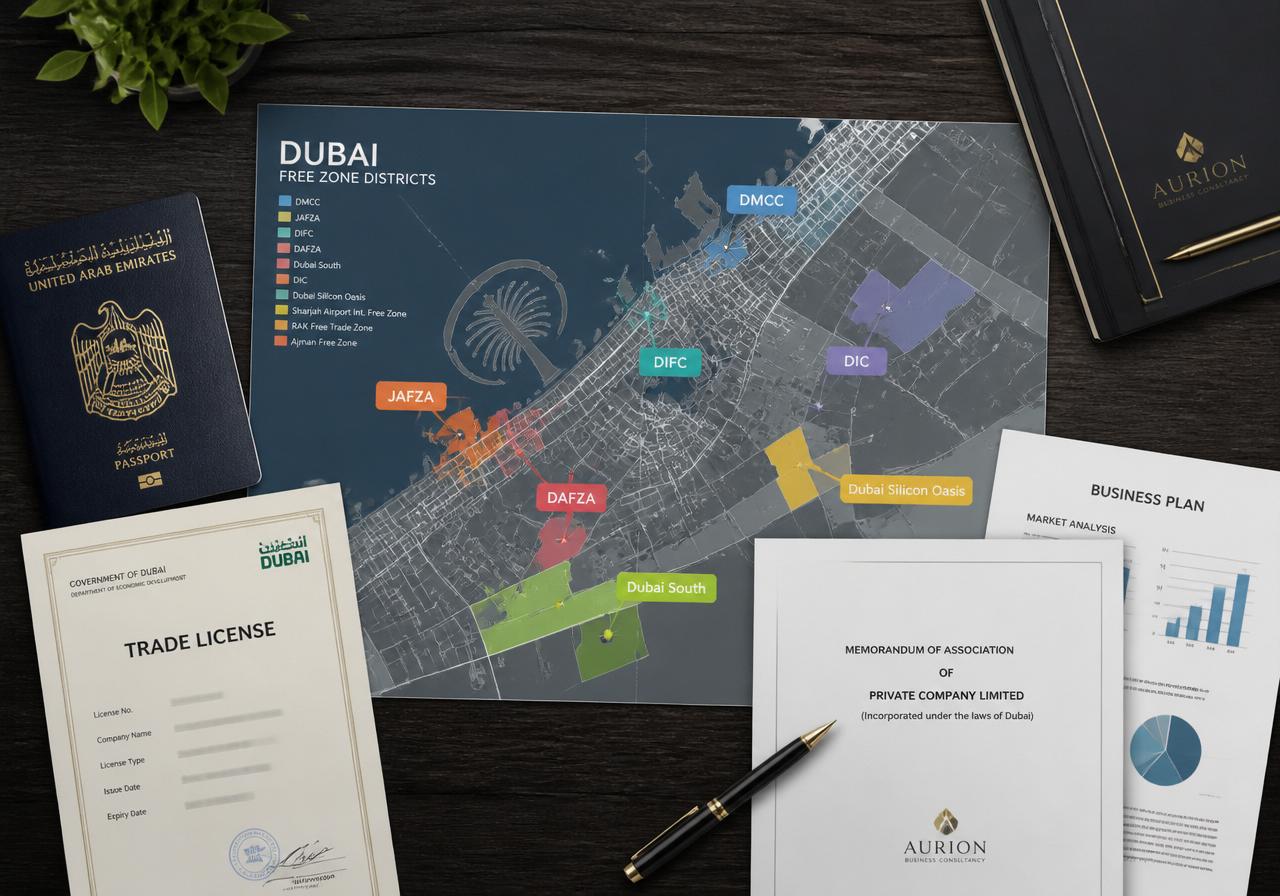
The activity you declare is the foundation of everything else — licence type, issuing authority, regulatory approvals, and in many cases which jurisdiction can host you. Be specific. Vague descriptions create problems at approval stage.
Mainland licences from the DED allow unrestricted UAE trading. Free zone licences from DMCC, JAFZA, DIFC and ADGM offer foreign ownership and tax efficiency but restrict local market access.
LLC for mainland multi-shareholder setups. FZ-LLC for free zones. Sole Establishment for solo professionals. Don't default to an LLC — in some scenarios it adds cost and complexity that isn't necessary.
Commercial, professional, industrial, or e-commerce. Regulated sectors — healthcare, financial services, legal, education — require external authority approval before issuance. Flag this early.
Mainland vs Free Zone: Which Is Right For You?
This is the most consequential decision in the entire company formation process. Both pathways now permit 100% foreign ownership, but they serve different commercial realities.
How to choose based on your business model
Two questions cut through most of the noise: who are your customers, and where are they? UAE-based clients point to mainland. International revenue points to free zone. If you're genuinely unsure, model both options against your actual business before committing.
The 12-Step Setup Process
The steps below assume the four decisions above are already settled. If they aren't, start there — every step compounds the consequences of an early misstep.
- 01Finalise your business activity
Identify exact activity codes from the DED list or your target free zone's register. Confirm whether multiple activities sit on one licence.
- 02Choose mainland or free zone
Apply the criteria above. Get a cost and restriction comparison done before you proceed.
- 03Select the legal structure
LLC, FZ-LLC, or Sole Establishment based on your ownership structure, activity type, and growth plans.
- 04Reserve your trade name
Through the DED portal or relevant free zone. Names must comply with UAE naming standards and reflect your licensed activity.
- 05Apply for initial approval
Government confirmation that activity, structure, and name are acceptable. Trigger external regulatory approvals here if required.
- 06Prepare the required documents
Passports, application forms, MOA for multi-shareholder setups. Corporate shareholders need attested parent-company documents.
- 07Secure office space if required
Mainland requires Ejari-registered tenancy. Free zones offer flexi desks. Your office determines your visa quota — calibrate it to actual headcount plans.
- 08Submit the licence application
Once documents and office are confirmed. Use current government fee schedules — they're revised periodically.
- 09Receive the trade licence
Standard activities: 3–10 business days. Regulated activities with external approvals: 3–6 weeks.
- 10Apply for visa, immigration card and Emirates ID
Begins once the licence is issued. Covers medical fitness test, biometrics and status change. Budget 2–4 weeks.
- 11Open a corporate bank account
The most underestimated step. UAE banks apply strict KYC — account opening for new companies takes 4–8 weeks. Start in parallel, not after.
- 12Begin operations and stay compliant
Annual licence renewal, FTA corporate tax registration, VAT above AED 375k, MOHRE compliance for employees. Penalties for missing them are real.
“The single most underestimated step is the corporate bank account. Start it in parallel with the licence — never after — and have a defensible source-of-funds narrative ready on day one.”
Documents Required to Start a Business in Dubai
- Colour passport copy
- UAE entry stamp or valid visa copy
- Passport-sized photograph
- Completed application forms (NOC if currently UAE-employed)
- Memorandum of Association (MOA)
- Parent-company Certificate of Incorporation (attested)
- Board Resolution authorising the UAE entity
- Parent-company MOA, attested and translated where required
- Trade licence
- Establishment card
- Entry permit and passport
- Medical fitness test and biometrics (in person)
- DHA — healthcare
- KHDA — education
- DFSA / SCA — financial services
- Dubai Municipality — food and beverage
How Much Does It Actually Cost?
Anyone quoting a flat fee without understanding your specific situation is guessing. Jurisdiction, activity type, legal structure, number of listed activities, office arrangement, and visa count all feed into the total. Use the ranges below to set a realistic first-year budget.
How Long Does It Take?
What can delay the process
Incomplete documents. Incorrectly attested corporate papers. A rejected trade name. An activity that triggers external approvals nobody flagged upfront. The most costly delays are always the preventable ones.
Common Types of Business Licences
Trading in physical goods — import, export, wholesale, retail and distribution. The most widely held licence type in Dubai.
Service and consultancy activities where the deliverable is expertise. Consultants, engineers, architects, IT providers, accountants.
Manufacturing, processing or assembly. Typically tied to dedicated industrial zones with appropriate infrastructure.
Dedicated frameworks via DED and Dubai CommerCity. Worth reviewing properly rather than defaulting to a generic commercial licence.
Frequently Asked Questions
Can foreigners start a business in Dubai?
Yes — without a local partner in most cases. The 2021 Commercial Companies Law reform extended 100% foreign ownership across the majority of mainland activities. A small number of strategic sectors carry different rules, but for most businesses the answer is straightforwardly yes.
Is mainland or free zone better for a new business?
Mainland if your customers are UAE-based. Free zone if your revenue is primarily international. Some businesses run both. The right answer comes from mapping your actual model against each option's constraints — not from a general rule.
How much does it cost to set up a business in Dubai?
A lean free zone setup: AED 18,000–30,000 in year one. A mainland LLC with office and visas: AED 35,000–70,000. Regulated sectors cost more. Confirm against current government fees.
How long does business setup take in Dubai?
Licence: 1 to 6 weeks depending on activity and jurisdiction. Bank account: 4 to 8 additional weeks. Plan for both simultaneously.