
Thinking of starting an import-export business in the UAE? You're entering one of the world's most connected trading markets. Strategically located between Asia, Europe, and Africa, the UAE has built a reputation as a global logistics and commerce hub, supported by world-class ports, modern infrastructure, and business-friendly regulations.
Whether you plan to import products into the UAE, export locally manufactured goods, or re-export products to international markets, obtaining the right import-export licence is one of the first and most important steps. A valid licence not only ensures legal compliance but also gives your business access to customs services, professional logistics providers, and international trading opportunities.
This guide explains everything you need to know about getting an import-export licence in the UAE, including eligibility, required documents, licensing costs, customs registration, and the differences between Mainland and Free Zone setups. If you'd rather skip the research and get it handled, Nexture's business setup team can manage the entire process for you.
Key Takeaways
An import-export licence is required for most businesses that trade goods into or out of the UAE.
Choosing between a Mainland and Free Zone company depends on your target market, operational needs, and expansion plans.
Businesses must complete customs registration and obtain a Customs Client Code from the relevant emirate before clearing shipments.
Proper licensing, documentation, and compliance help prevent shipment delays, penalties, and regulatory issues.
The UAE's strategic location, advanced logistics infrastructure, and pro-business environment make it one of the world's leading destinations for international trade.
What Is an Import-Export License in the UAE?
An import-export licence is a commercial authorisation that allows businesses to legally import, export, and re-export goods through the UAE's ports, airports, and land borders. It is issued as part of a commercial or trading licence and works alongside customs registration, enabling businesses to move goods through official trade channels.
If your company plans to buy products from overseas suppliers, export goods manufactured in the UAE, or participate in international trading, this licence is essential. Without the appropriate approvals, customs authorities may delay or reject shipments, resulting in additional costs and operational disruptions.
For example, a company importing consumer electronics from China for distribution across the UAE must first obtain a trading licence and register with the relevant customs authority before shipments can be cleared.
Beyond legal compliance, an import-export licence offers several business advantages:
Benefit | Why It Matters |
Legal compliance | Operate in accordance with UAE commercial and customs regulations. |
Customs access | Clear goods through UAE ports and airports without unnecessary delays. |
Business credibility | Build trust with suppliers, logistics companies, and international partners. |
Market expansion | Trade with customers and suppliers across global markets. |
For businesses looking to scale internationally, obtaining the correct licence is the foundation of efficient and compliant trade operations.
Who Needs an Import-Export License?
Most businesses involved in buying or selling physical goods across international borders require an import-export licence. If your operations involve regularly importing products into the UAE or exporting goods to overseas markets, licensing and customs registration are generally mandatory.
Common businesses that require an import-export licence include:
Wholesale trading companies
General trading businesses
E-commerce businesses importing inventory
Manufacturing companies exporting finished products
Retail businesses sourcing products internationally
Logistics and supply chain companies managing international shipments
Some industries also require additional approvals from relevant authorities. Businesses dealing in food products, pharmaceuticals, medical devices, chemicals, cosmetics, or telecommunications equipment may need permits before importing or exporting these goods.
Quick Checklist
You will likely need an import-export licence if you:
Import products for resale in the UAE.
Export goods manufactured in the UAE.
Re-export products through UAE ports.
Operate an e-commerce business selling internationally.
Trade products with suppliers or customers outside the UAE.
If any of these apply to your business, it's important to determine the appropriate licence type and register with the relevant customs authority before commencing trade.
Note: Before applying, map out your entire supply chain, including suppliers, storage facilities, shipping routes, and target markets. This helps you choose the correct business activity and avoids costly amendments after your licence has been issued.
Mainland vs Free Zone Import Export License in the UAE
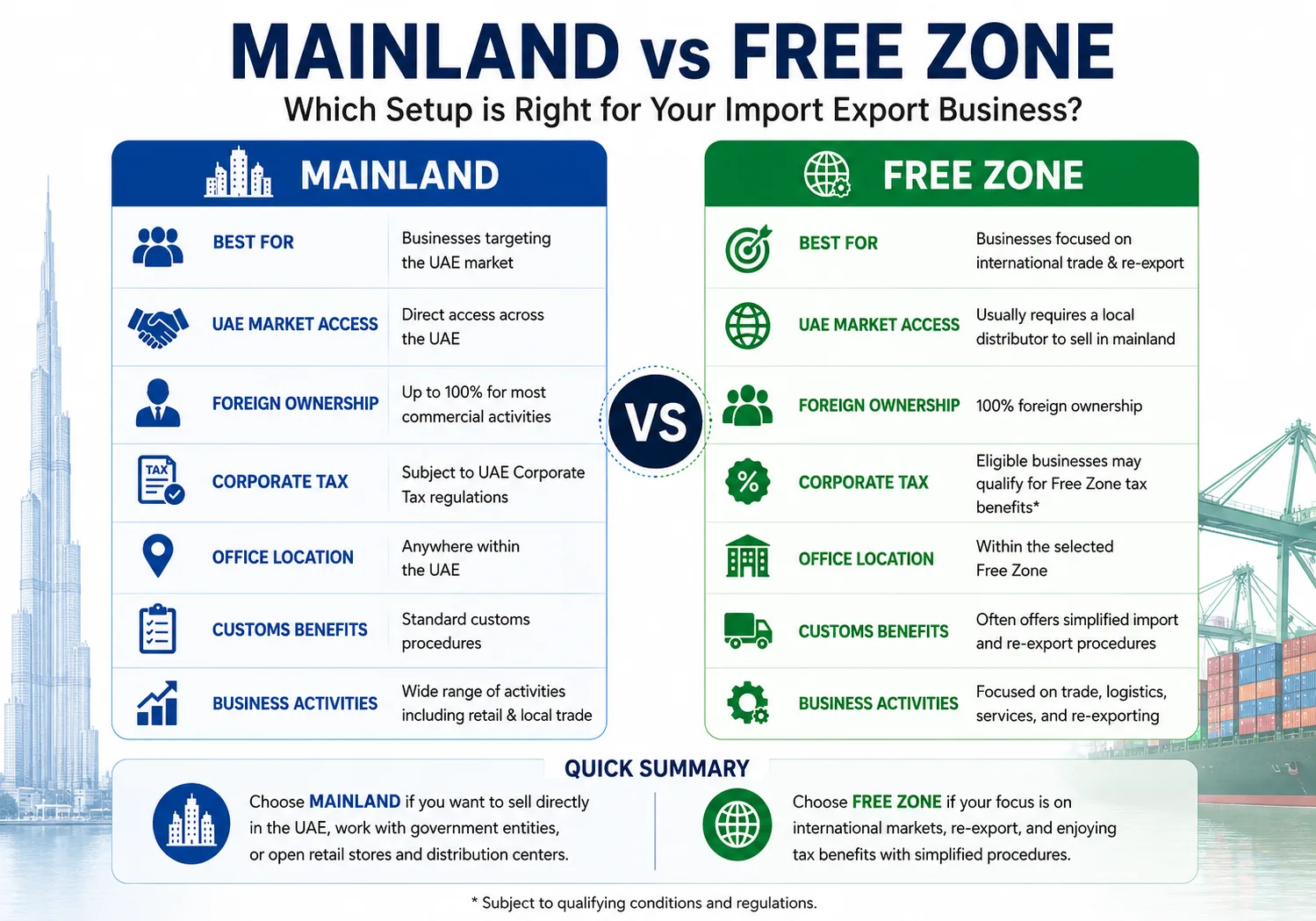
Choosing between a Mainland and Free Zone setup is one of the most important decisions when starting an import-export business in the UAE. The right option depends on your target market, operational requirements, and long-term business goals.
A Mainland company is ideal if you plan to trade directly within the UAE, work with government entities, or establish a physical presence across the Emirates. On the other hand, a Free Zone company is often the preferred choice for businesses focused on international trade, thanks to streamlined company formation, customs benefits, and attractive tax incentives for eligible businesses under the UAE Corporate Tax framework.
While both options allow 100% foreign ownership for most business activities, they differ in terms of market access, customs procedures, and operating flexibility.
Feature | Mainland Company | Free Zone Company |
Best For | Businesses targeting the UAE market | Businesses focused on international trade and re-export |
UAE Market Access | Direct access across the UAE | Usually requires a local distributor to sell in the mainland |
Foreign Ownership | Up to 100% for most commercial activities | 100% foreign ownership |
Corporate Tax | Subject to UAE Corporate Tax regulations | Eligible businesses may qualify for Free Zone tax benefits |
Office Location | Anywhere within the UAE | Within the selected Free Zone |
Customs Benefits | Standard customs procedures | Often offers simplified import and re-export procedures |
Which Setup Should You Choose?
Choose a Mainland licence if you:
Sell products directly within the UAE.
Want to work with government entities.
Plan to open retail stores or local distribution centres.
Need unrestricted access to the domestic market.
Choose a Free Zone licence if you:
Import products for re-export.
Serve international clients.
Operate an e-commerce or trading business focused on overseas markets.
Want a simplified business setup process within a specialised trade ecosystem.
For example, a company importing consumer electronics from China and distributing them across Dubai supermarkets would typically benefit from a Mainland licence. In contrast, a business importing products into Jebel Ali Free Zone for re-export to Africa or Europe may find a Free Zone setup more cost-effective.
Business Activities Covered Under an Import Export License
An import-export licence can support a wide range of trading activities, depending on the business activity selected during company formation. Businesses that require greater flexibility often choose a General Trading Licence, which allows multiple product categories to be traded under a single licence, subject to applicable regulations.
Selecting the correct business activity from the outset is important. Choosing the wrong activity may lead to additional approvals, licensing amendments, or delays when expanding your operations.
Some of the most common industries include:
Industry | Typical Products | Market Demand |
Electronics | Mobile phones, laptops, and accessories | High |
Consumer Goods | Household products, personal care items | High |
Automotive | Spare parts, tyres, lubricants | High |
Fashion & Apparel | Clothing, footwear, accessories | High |
Food & Beverages | Packaged food, beverages, ingredients | High (additional approvals required) |
Industrial Equipment | Machinery, construction equipment | Moderate to High |
Medical Supplies | Healthcare products and equipment | High (regulated sector) |
Businesses dealing in regulated products, including pharmaceuticals, food, chemicals, cosmetics, and telecommunications equipment, must obtain approvals from the relevant UAE authorities before importing or exporting these goods. If your business plans to expand into multiple product categories, discuss a General Trading Licence with your business setup consultant. It can provide greater flexibility than applying for separate licences later.
Requirements to Start an Import-Export Business in the UAE
Setting up an import-export business in the UAE involves more than obtaining a licence. Choosing the right business structure and completing the required registrations early can save time and prevent costly delays.
- Choose Your Business Jurisdiction
Decide whether to establish your company in the Mainland or a Free Zone. Your choice affects market access, customs procedures, operational flexibility, and long-term expansion opportunities.
- Select the Appropriate Business Activity
Choose the trading activity that best reflects your business model. This determines the type of licence you will receive and whether additional approvals are required.
- Reserve Your Trade Name
Submit your preferred business name to the relevant licensing authority. The name must comply with UAE naming regulations and be available for registration.
- Apply for Your Commercial or Trading Licence
Once your jurisdiction, activity, and trade name have been approved, submit your application along with the required documentation. The relevant authority will review your application before issuing your licence.
- Register with Customs
After obtaining your licence, register your business with the customs authority in the emirate where your company operates. Once approved, you'll receive a Customs Client Code, allowing your business to import and export goods through official ports and airports.
- Obtain Additional Approvals (If Required)
Businesses trading regulated products may need approvals from authorities responsible for health, food safety, telecommunications, or environmental compliance before shipments can be cleared. Nexture's PRO and government liaison services can manage these approvals on your behalf.
Documents Required for an Import Export License in the UAE
Preparing the required documents in advance can significantly speed up the licensing process. While the exact requirements may vary depending on whether you establish your company in the Mainland or a Free Zone, most businesses are asked to submit a similar set of documents.
Having complete and accurate documentation also makes customs registration smoother and reduces the chances of delays or application rejections.
Document
Purpose
Passport copies of shareholders
Verify the identity of business owners
Passport-sized photographs
Required for company registration
Trade name reservation certificate
Confirms the approved business name
Initial approval certificate (where applicable)
Authorises the business setup process
Memorandum of Association (MOA) or legal documents
Defines company ownership and structure
Office lease agreement or Ejari (if required)
Confirms the company's registered address
Business licence application
Official request for licence issuance
Customs registration documents
Required to obtain a Customs Client Code
Depending on your business activity, authorities may request additional documentation.
For example:
Food products may require approvals from the relevant food safety authority.
Pharmaceuticals and medical devices require approvals from the Ministry of Health and Prevention (MOHAP).
Telecommunications equipment may require approval from the Telecommunications and Digital Government Regulatory Authority (TDRA).
Cosmetics and personal care products may require product registration before import.
Step-by-Step Application Process
Obtaining an import-export licence is relatively straightforward when approached systematically. While processing times vary depending on the licensing authority and business activity, most applications follow the same sequence.
- Register Your Company
Choose your preferred jurisdiction, business activity, and legal structure before submitting your company registration application.
- Obtain Your Commercial or Trading Licence
Once your application is approved, the licensing authority will issue your commercial or general trading licence, allowing your company to legally conduct trading activities.
- Register with the Customs Authority
After receiving your business licence, register with the customs authority in the emirate where your company is established. Upon successful registration, you'll receive a Customs Client Code, which identifies your business during customs clearance.
- Activate Logistics and Banking Services
Before trading internationally, you'll typically need to:
Open a corporate bank account.
Partner with freight forwarders or logistics providers.
Set up shipping and warehousing arrangements.
Register with courier providers if operating an e-commerce business.
- Start Importing and Exporting
Once your customs registration is complete, your business can begin importing, exporting, or re-exporting goods through UAE ports, airports, and land borders.
Typical Processing Timeline
Stage | Estimated Time |
Trade name reservation | 1–2 business days |
Licence approval | 3–10 business days |
Customs registration | 1–5 business days |
Additional approvals (if required) | Varies by authority |
Note: Timelines are indicative and may vary depending on the emirate, business activity, and completeness of the application.
Import Export License Cost in the UAE
The cost of obtaining an import-export licence varies depending on several factors, including the jurisdiction, licence type, office requirements, visa allocations, and government fees.
Rather than focusing only on the licence fee, businesses should budget for the complete setup cost.
In a 30-minute call we map your situation against jurisdiction, activity and cost — no commitment required.
Typical Cost Components
Expense | Description and Approximate Cost(AED) |
Trade licence | Primary licence issued by the licensing authority/10,000–20,000 |
Company registration | Government incorporation fees/600–1,500 |
Customs registration | Required for import and export activities/200–500 |
Establishment card | Required for visa processing/700–2,000 |
Office or warehouse | Physical office, flexi-desk, or warehouse rental/7,500–40,000 |
Visa fees | Investor and employee visas/3,500–6,000 |
Banking and administrative expenses | Corporate account setup and miscellaneous costs/Usually free |
Estimated Total Setup Cost
Business Setup | Approximate First-Year Cost |
Budget Free Zone | AED 12,000–20,000 |
Premium Free Zone (e.g., DMCC, JAFZA) | AED 25,000–45,000+ |
Mainland Company | AED 30,000–65,000+ |
Note: These figures are indicative and may vary depending on the emirate, licensing authority, business activity, office size, visa quota, and any additional approvals required. Requesting a personalised quotation from your chosen authority or business setup consultant is the best way to estimate your actual costs
For businesses operating from a Free Zone, some authorities offer bundled packages that combine licensing, office space, and visas into a single setup cost.
Mainland businesses may have different fee structures depending on their location and operational requirements.
Note: Licence fees change periodically and differ across jurisdictions. Always request an official quotation from the relevant licensing authority or a trusted business setup consultant before making financial decisions.
Cost-Saving Tips
Compare multiple Free Zone packages before deciding.
Choose a business activity that aligns closely with your operations to avoid future amendment fees.
Budget for annual licence renewals in addition to your initial setup costs.
Consider future expansion plans when selecting office space and visa quotas.
Compliance Requirements for Import-Export Businesses
Obtaining your licence is only the beginning. Maintaining compliance with UAE regulations is essential for avoiding shipment delays, financial penalties, and operational disruptions.
Successful trading businesses establish compliance processes from the start rather than treating them as an afterthought.
We’ll model the requirements and send back a single-page breakdown within 24 hours.
Key Compliance Requirements
Maintain Customs Registration
Keep your Customs Client Code active and ensure company information remains up to date with the relevant customs authority.
Maintain Accurate Records
Store invoices, shipping documents, customs declarations, purchase orders, and commercial contracts for the period required under UAE regulations.
Proper documentation simplifies customs inspections and financial audits.
Renew Your Business Licence
Import-export licences require periodic renewal.
Late renewals may result in fines or interruptions to business operations.
Obtain Additional Approvals
Businesses importing regulated products- including food, pharmaceuticals, chemicals, and medical equipment, must ensure all permits remain valid before importing shipments.
Stay Updated on Regulatory Changes
Import duties, customs procedures, sanctions, and product regulations may change over time.
Regularly reviewing updates from the relevant authorities helps businesses remain compliant and avoid unnecessary disruptions.
Compliance Checklist
Renew your trade licence on time.
Maintain an active Customs Client Code.
Keep accurate business and customs records.
Renew industry-specific permits when required.
Monitor regulatory updates affecting your products.
Work with experienced customs brokers or logistics partners where necessary.
Ready to Start Your Import-Export Business in the UAE?
Setting up an import-export company doesn't have to be complicated. With the right guidance, you can complete the licensing process efficiently and focus on growing your business.
Nexture's business setup specialists can help you:
Choose the right Mainland or Free Zone jurisdiction.
Obtain your commercial or General Trading Licence.
Complete customs registration and documentation.
Secure industry-specific approvals where required.
Ensure compliance with UAE regulations from day one.
Contact Nexture today for personalised guidance and a tailored business setup solution.