
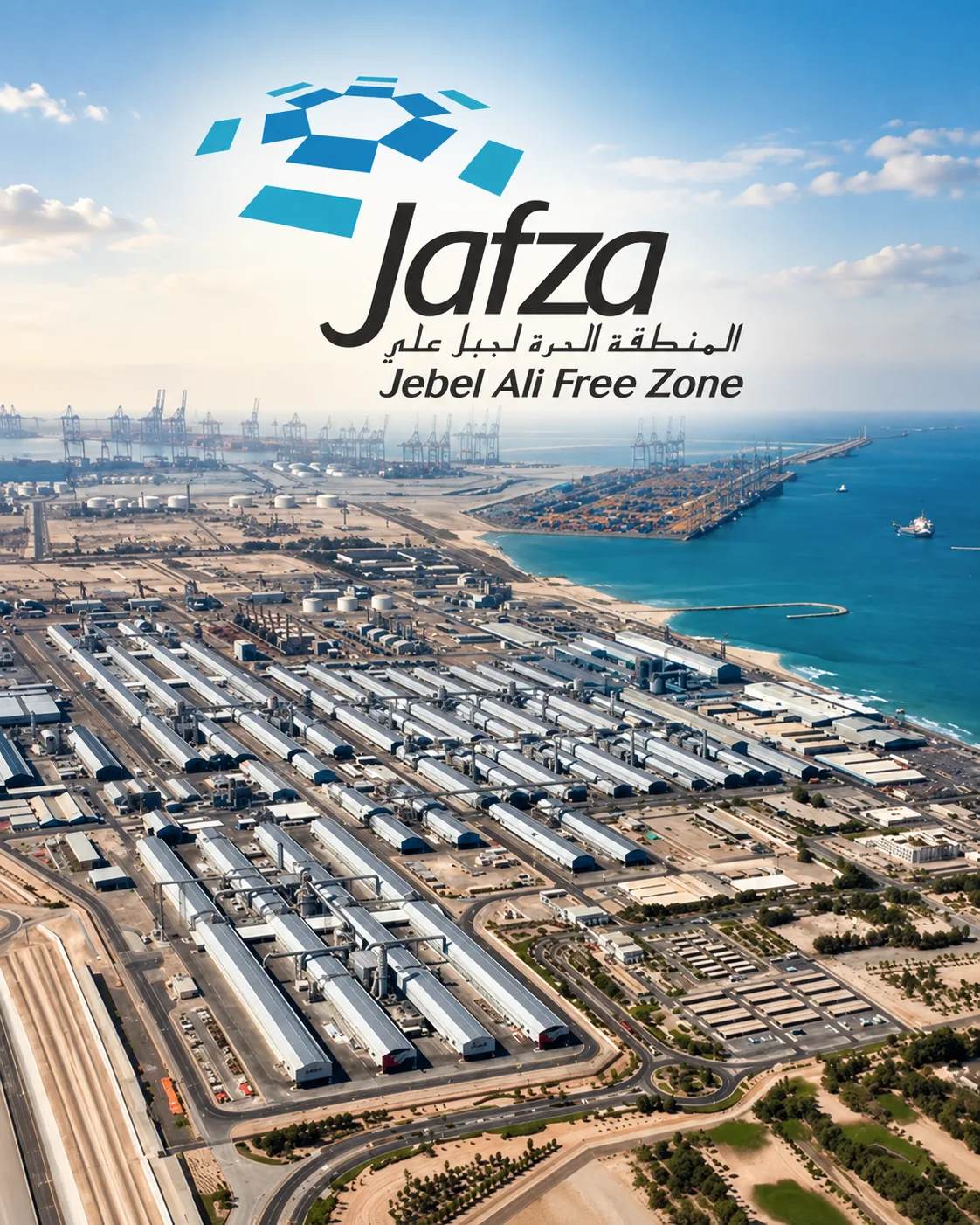
If you are researching business locations in Dubai, you may be wondering: What is JAFZA and why do large trading and logistics companies choose it?
JAFZA stands for Jebel Ali Free Zone. It is a major business and industrial district connected to Jebel Ali Port in Dubai. The free zone is operated by DP World and supports more than 11,000 businesses, including multinational companies, manufacturers, distributors, logistics operators and regional headquarters.
JAFZA is particularly useful when your company needs to import goods, hold stock, re-export products, operate a warehouse or serve markets across the Middle East, Africa and Asia.
This guide explains how a JAFZA company setup works, which licence you may need and what you should budget for.
What Is JAFZA?
JAFZA is a free zone located in the Jebel Ali area of Dubai. It covers around 57 square kilometres and forms part of the wider Jebel Ali trade and logistics network.
Businesses registered in JAFZA operate under the free zone’s regulations. Depending on the selected legal structure, shareholders can own 100% of the company without appointing a UAE national shareholder. JAFZA offers several company structures, including:
Free Zone Establishment, or FZE, for a single shareholder
Free Zone Company, or FZCO, for multiple shareholders
Public Listed Company
Branch of an existing UAE or foreign company
JAFZA offshore company
An FZE or FZCO is a separate legal entity. A branch remains legally connected to its parent company and generally operates under the parent company’s name and approved activities.
JAFZA does not currently prescribe one fixed minimum share capital for every FZE or FZCO. However, your proposed capital should be suitable for the company’s activities, size and financial responsibilities.
Companies looking for professional assistance can review business setup services in Dubai before choosing their structure.
In a 30-minute call we map your situation against jurisdiction, activity and cost — no commitment required.
Jebel Ali Free Zone in Dubai
JAFZA’s main advantage is its location beside Jebel Ali Port, one of the region’s largest container and cargo hubs.
This makes the free zone suitable for businesses that regularly receive, store, process or re-export goods. A shipment can arrive at the port and move into a JAFZA facility without travelling through central Dubai. This can reduce local transport time and simplify cargo handling.
The wider area supports several industries, including:
Logistics and freight forwarding
Automotive products
Food and agricultural goods
Electronics
Chemicals and petrochemicals
Construction materials
Machinery and equipment
Healthcare products
Retail and e-commerce
Manufacturing and assembly
JAFZA also provides access to offices, warehouses, industrial plots and showrooms. Your choice of facility should match your actual operation rather than your company image.
Why Choose JAFZA for Business Setup?
Direct access to port and logistics services
JAFZA works well for companies that depend on sea freight, containers, storage and regional distribution.
Jebel Ali Port access can make inventory movement easier, especially when goods arrive in bulk and are later re-exported. Logistics companies also benefit from the wider network of shipping lines, freight forwarders, customs agents and warehouse operators located in the area.
100% foreign ownership
Foreign individuals and overseas corporate shareholders can own a JAFZA FZE or FZCO without a local shareholder. This gives the owners control over management, voting rights and profit distribution, subject to the company’s constitutional documents.
Multiple facility options
JAFZA provides several facility categories. These include offices, warehouses, showrooms and industrial land.
The facility is a major part of the setup decision because every JAFZA company formation normally requires a suitable lease arrangement. The facility also affects operating costs, storage capacity and potential staffing requirements.
Suitable for regional trade
A company can use JAFZA as a base for importing goods and distributing them to customers in the UAE or overseas.
Goods entering an authorised free zone may receive special customs treatment while they remain within the free zone. Customs duty can become payable when goods are released into the UAE mainland, depending on their classification, destination and the applicable customs rules. Dubai’s standard customs duty is commonly 5% of the cost, insurance and freight value, although different rates and exemptions can apply.
Established business environment
JAFZA has operated for decades and supports companies ranging from small trading businesses to global industrial groups. It offers a structured environment for licensing, leasing, customs coordination and employee immigration.
You can also review free zone company formation services before comparing JAFZA with other Dubai free zones.
Who Should Set Up a Business in JAFZA?
JAFZA is commonly suitable for businesses with a clear need for port access, warehousing, industrial space or regional distribution.
Trading companies
A trading business importing products in commercial quantities may benefit from JAFZA’s location and storage options. This includes electronics, automotive parts, machinery, building materials and consumer goods.
Logistics and shipping businesses
Freight forwarders, third-party logistics companies, shipping support businesses and cargo handling firms can operate close to Jebel Ali Port and other logistics providers.
Manufacturing companies
JAFZA can accommodate light and large-scale industrial activities, subject to licence approval, technical requirements and environmental or safety approvals.
Import and export businesses
A company that imports products and re-exports them to other countries may find JAFZA more practical than a location focused mainly on office-based services.
Regional headquarters and distribution firms
International groups may use a JAFZA entity to manage procurement, distribution, regional administration or supply chain operations.
JAFZA may be less suitable for a small freelancer or consultant who needs one visa and a basic desk. In that situation, a lower-cost free zone could offer a simpler setup.
Types of Licences Available in JAFZA
JAFZA’s current main business setup pages list four core licence categories: trading, service, industrial and logistics. Your approved business activities appear under the selected licence.
Trading Licence
A trading licence allows your company to buy, sell, import and export approved goods.
The activities should match the products you plan to trade. For example, a company approved for machinery trading should not automatically assume it can trade food, cosmetics or medical products.
Some goods require extra approvals from UAE authorities. Regulated products may include pharmaceuticals, food items, chemicals, telecommunications equipment and certain industrial materials.
Review the official JAFZA business activity list before submitting your application.
Service Licence
A service licence covers approved professional or commercial services. Possible activities may include consulting, management support, technology services and other specialised work.
Your company should only provide services listed on its licence. Certain professional activities may also require qualifications or approval from another authority.
Industrial Licence
An industrial licence is intended for manufacturing, processing, assembly, production or related industrial activities.
Your application may require technical information about the proposed operation, machinery, production process, raw materials, power requirements and waste management. Industrial companies may also need health, safety, environmental or civil defence approvals.
Logistics Licence
A logistics licence can cover approved logistics and supply chain activities. These may include storage, transportation coordination, freight-related services or distribution support.
The exact activities and approvals will depend on your operating model and the services you provide.
E-Commerce Activities
JAFZA supports retail and e-commerce businesses, but its main company setup pages do not currently present e-commerce as a separate fifth core licence category.
An online seller may need suitable commercial activities under an approved licence. The correct structure can depend on the products, storage method, online sales model and target market. Confirm the activity classification with JAFZA before paying any fees.
Documents Required for JAFZA Company Setup
- The documents depend on whether the shareholders are individuals or companies.
- Individual shareholders commonly need:
Clear passport copies
Passport-size photographs
Residential address and contact details
Proposed company names
Business activity information
Completed application forms
Shareholder and manager details
Business plan where requested
When a company will hold shares in the new JAFZA entity, additional corporate documents may include:
Certificate of Incorporation
Memorandum and Articles of Association
Certificate of good standing or incumbency
Board resolution approving the investment
Register of shareholders and directors
Ultimate beneficial owner information
Passport copies of authorised signatories
Foreign corporate documents may need notarisation, legalisation and certified translation.
Prepare these documents early. Corporate legalisation can take longer than the actual licence application.
For businesses completing the process outside the UAE, this guide to setting up a Dubai company remotely explains some of the planning involved.
How to Set Up a Company in JAFZA
- Choose Your Business Activity
Begin with a precise list of activities.
Do not choose a broad description such as “general business” when your actual plan is to import auto parts and distribute them across the Gulf. The chosen activities determine the licence type, facility requirements and outside approvals.
- Select the Company Structure
Choose between an FZE, FZCO, a branch or another available structure.
A single individual or corporate shareholder may use an FZE. Two or more shareholders may consider an FZCO. An established foreign business can open a branch when it wants the UAE operation to remain legally connected to the parent company.
- Reserve the Trade Name
Submit preferred company names that comply with UAE and JAFZA naming rules.
Avoid names containing protected government terms, offensive language or references to activities you are not licensed to conduct. Keep alternative names ready in case your first option is unavailable.
- Submit the Application and Documents
Complete the application and submit shareholder, manager, activity and corporate documents.
JAFZA may request more information depending on the ownership structure and proposed operation. Applications involving regulated goods, manufacturing or industrial processes usually require more review.
JAFZA states that company formation can take around 3 to 14 business days after complete documents are submitted, depending on the structure, licence, activities and lease arrangement.
- Choose the Facility Type
Select an office, warehouse, showroom, industrial unit or plot.
Do not sign a large warehouse lease before checking your storage volume, racking requirements, loading access, power supply and employee needs. At the same time, avoid choosing a facility that is too small for your projected inventory.
- Pay the Fees and Receive the Licence
After approval, pay the registration, licence and facility charges.
You will then receive the company incorporation and licence documents. JAFZA licences are generally issued for one year and must be renewed annually. After incorporation, you can proceed with immigration registration, visas, customs arrangements and bank account applications.
We’ll model the requirements and send back a single-page breakdown within 24 hours.
JAFZA Visa and Employee Options
A JAFZA company can apply for residence visas based on its licence, facility, operational requirements and approvals.
Investor or partner visa
A shareholder may apply for a partner or investor residence visa. JAFZA’s published guidance states that a shareholder applying through this category should generally hold shares worth at least AED 50,000 and provide the required shareholder confirmation.
Employee visa
The company can sponsor employees after completing the required establishment and immigration procedures.
JAFZA’s published fee guide lists a normal employment entry permit package at AED 2,378 for one year and AED 2,678 for two years. These figures are subject to change and may exclude medical testing, Emirates ID, insurance, in-country processing and other charges.
Dependant visa
Eligible residents may sponsor a spouse, children and other qualifying dependents under UAE immigration rules.
ICP guidance states that family sponsorship commonly requires a monthly salary of at least AED 4,000 or AED 3,000 with employer-provided accommodation. Proof of relationship, suitable accommodation and other documents are also required. Eligibility can change based on the dependent category and the sponsor’s status.
Visa quota
Do not assume that a small office will provide an unlimited employee quota. Staffing approval can depend on the facility, licence, business activity and operational need.
Estimate your team size before choosing the premises. Relocating or upgrading a facility later can add cost and delay recruitment.
JAFZA Business Setup Cost
There is no single fixed JAFZA business setup cost for every company. The final amount depends heavily on the licence, facility and visa requirements.
Your budget may include:
Company registration fee
Jebel Ali Free Zone licence fee
Office, warehouse or land lease
Facility deposit
Immigration establishment charges
Investor and employee visa fees
Medical fitness testing
Emirates ID charges
Health insurance
Customs registration
Document legalisation
Regulatory approvals
Annual licence and lease renewal
Accounting, tax and audit costs
A warehouse-based trading company will cost more than a service company using a standard office because the facility expense is larger.
Use the official JAFZA cost calculator for an initial estimate. Request a written quotation that clearly separates licence, registration, facility, visa and refundable deposit charges.
You should also plan for UAE corporate tax compliance. Free zone status does not automatically mean that every profit receives a 0% corporate tax rate. A qualifying free zone person may receive a 0% rate on qualifying income when all legal conditions are met. Other taxable income may be subject to the standard corporate tax rules. Free zone companies must also complete the required corporate tax registration.
Read the FTA guidance for free zone persons before building tax benefits into your financial projections.
Common Mistakes to Avoid
Choosing JAFZA only for prestige
JAFZA is respected, but its name alone should not decide your location. Choose it when the port, warehouse facilities, industrial space or logistics network provides a real business benefit.
Ignoring facility costs
The lease may be one of your largest annual expenses. Review service charges, deposits, fit-out costs, utilities, loading access and renewal terms before signing.
Selecting the wrong licence activity
Incorrect activities can create problems with customs, banking, supplier contracts and regulatory approvals. Describe your actual products and services clearly during the application.
Underestimating logistics needs
Calculate expected shipment size, container frequency, storage period and local delivery requirements. A facility that works during the first three months may become unsuitable once sales increase.
Not planning the visa quota early
Prepare a staffing plan before selecting your facility. Include managers, warehouse workers, sales staff, drivers and administrative employees.
Assuming all free zone income is tax-free
Corporate tax treatment depends on the company’s transactions, customers, activities and compliance with qualifying free zone rules. Obtain tax advice based on your actual revenue model.
More practical compliance and company formation articles are available in Nexture’s UAE business setup guides.
Conclusion
JAFZA is a strong business location for companies involved in trade, manufacturing, logistics, warehousing and regional distribution.
Its port access, foreign ownership rules and range of commercial and industrial facilities make it attractive to businesses handling physical goods. However, the setup requires careful planning. Your licence, activities, facility, visa quota, customs model and tax position should all support the way your company will actually operate.
Before applying, prepare a clear business plan and request a full cost breakdown. Compare JAFZA with other free zones based on operational needs rather than reputation alone.
For help reviewing your activities, facility requirements and estimated setup cost, you can speak with our business setup consultant Experts at Nexture.