
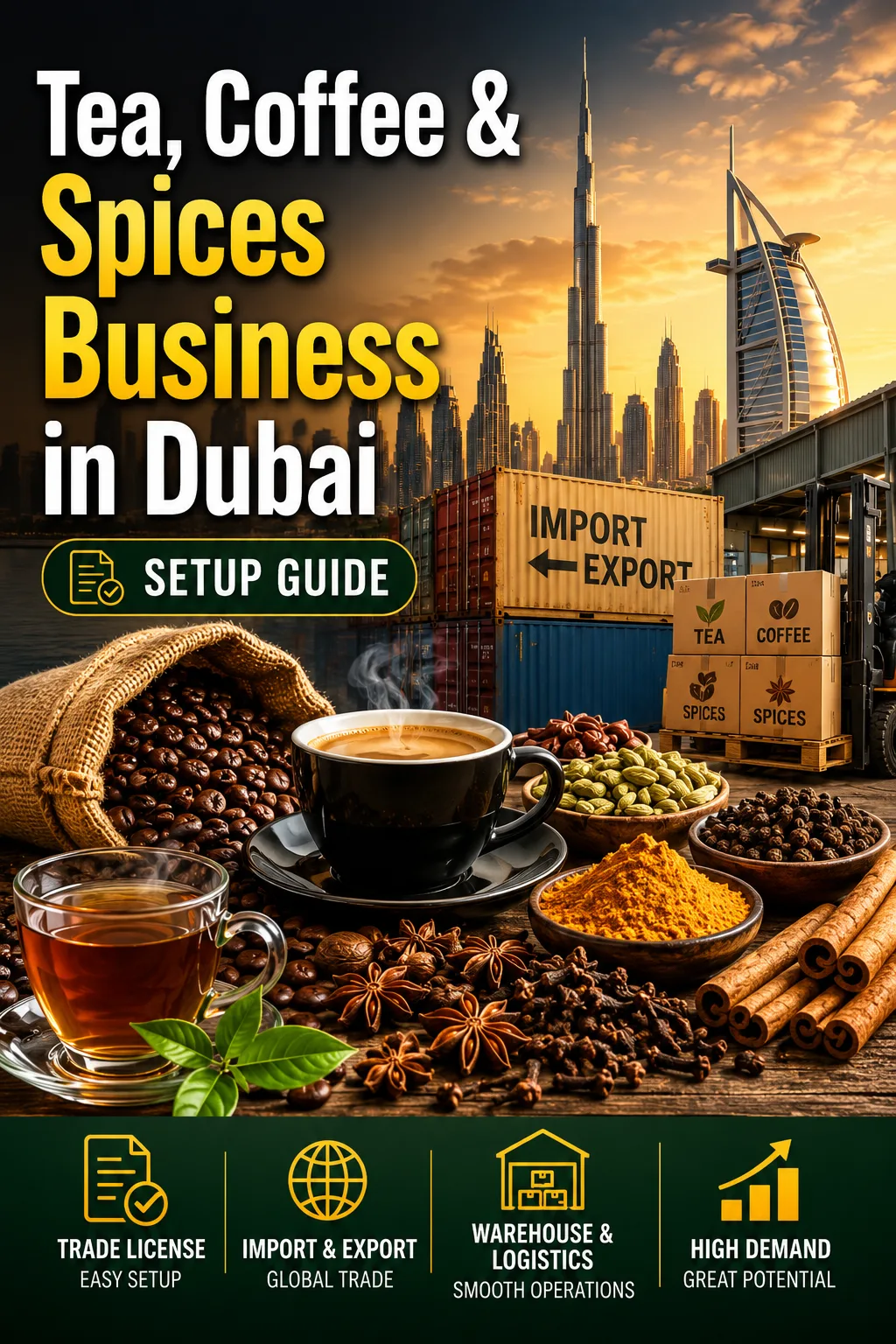
Dubai is a major entry point for food products moving into the UAE and surrounding markets. Tea from India and Sri Lanka, coffee from Ethiopia and Brazil and spices from South Asia can all reach regional buyers through Dubai’s ports, airports and distribution networks.
The scale of the food trade is significant. Dubai Municipality reported that 173,775 food shipments totalling 4.9 million tonnes were cleared through Dubai’s ports during the first half of 2025. It also registered 77,700 new food products during the same period.
This creates room for importers, wholesalers, e-commerce sellers and regional distributors. However, starting a tea, coffee and spices business in Dubai requires more than obtaining a standard commercial licence. You must select the correct activities, follow food safety rules, register imported products where required and arrange suitable storage.
This guide explains how the setup works and what you should check before placing your first order.
Key Takeaways
You need a commercial licence that covers the exact products and sales channels you plan to use.
Mainland companies are usually better for direct sales within the UAE.
Free zone companies are often suitable for importing, exporting and re-exporting goods.
Imported food products may require label assessment, product registration and shipment-release approval.
Coffee roasting, spice grinding, tea blending and repacking may require extra activities beyond a normal trading licence.
A small setup may begin within the wider AED 12,000 to AED 50,000 company formation range, but storage, visas, product approvals and stock increase the total cost.
In a 30-minute call we map your situation against jurisdiction, activity and cost — no commitment required.
What Is a Tea, Coffee and Spices Trading Business in Dubai?
A tea, coffee and spices trading business is related to the import, export, distribution or sale of packaged food products. The business may supply supermarkets, grocery stores, hotels, restaurants, cafés, catering companies and individual customers.
You can operate through several models:
Wholesale supply to retailers and hospitality businesses
Import and local distribution
Export and re-export
Online sales through a website or marketplace
Retail sales through a physical shop
Private-label product distribution
Corporate gifting and speciality product boxes
Your licence must match what you actually do. A company that only imports sealed coffee packets needs different activities from a company that roasts beans and packs them under its own brand.
The same rule applies to spices. Importing sealed turmeric, pepper or cardamom is a trading activity. Grinding, mixing or repacking those products may be treated as food processing, packaging or manufacturing.
Dubai Municipality oversees the safety of imported food products and food-related activities in the emirate. This includes controls covering products, establishments and food imports.
Why Start This Business in Dubai?
Dubai gives food traders access to a large local customer base and established international trade routes.
Tea, coffee and spices are used by households as well as hotels, restaurants, catering businesses and food manufacturers. Demand comes from regular daily consumption, hospitality orders, speciality cafés, gifting products and ethnic food markets.
Dubai is also suitable for regional distribution. A shipment can arrive through a Dubai port, move into approved storage and then be distributed within the UAE or re-exported to another country.
You do not need to begin with a large operation. A new trader may start with a limited product range, such as five speciality teas or ten premium spice products. Larger companies may import full containers and supply supermarket chains or regional distributors.
The business can also combine physical distribution with online sales. Before adding an online store or marketplace channel, check that your licence includes the required ecommerce or online trading activity. Nexture’s Dubai ecommerce licence guide explains the main setup points for online sellers.
Main Business Activities You Can Choose
The exact activity names differ between licensing authorities. Search the official Invest in Dubai business activities portal before submitting your application.
Business activity | What it usually covers |
Tea trading | Importing, exporting and distributing packaged tea |
Coffee trading | Trading packaged coffee beans, ground coffee and related products |
Spices trading | Trading whole or packaged spices |
Foodstuff trading | Trading a broader range of permitted food products |
Wholesale distribution | Supplying products in bulk to retailers and commercial buyers |
Import and export trading | Moving permitted products into and out of the UAE |
Ecommerce | Selling approved products through websites and online marketplaces |
Food packaging | Packing or repacking products for commercial sale |
Food processing | Grinding, blending, roasting or otherwise processing food |
Do not choose a broad activity simply because it sounds convenient. Confirm that it covers every planned product and process.
For example, a coffee trading business in Dubai may buy sealed bags from an overseas roaster and sell them locally. If the business plans to roast green beans inside Dubai, it will probably need a suitable processing or industrial activity and approved premises.
The same distinction applies to tea blending and spice grinding. Explain your complete workflow to the licensing authority before paying the licence fee.
Mainland vs Free Zone Setup
You can establish the company on the Dubai mainland or in a free zone. The better option depends on your customers, storage plan and supply chain.
Factor | Mainland company | Free zone company |
Direct UAE sales | Suitable for direct sales across the UAE | Local sales may require an approved mainland route or distributor |
Import and export | Permitted with customs and product approvals | Well suited to international trade and re-export |
Retail shop | Suitable for opening a shop in Dubai | Usually limited to the rules and facilities of the chosen zone |
Warehousing | Can lease approved premises in mainland locations | Warehouses may be available within or through the free zone |
Customer type | Retailers, restaurants, supermarkets and consumers | Overseas customers, distributors and re-export buyers |
Office requirement | Commercial premises and Ejari are generally required | Flexi-desk or shared facilities may be available |
Licensing authority | Dubai Department of Economy and Tourism | Relevant free zone authority |
When Mainland Makes Sense
A mainland company is usually the stronger option when most of your customers are inside the UAE.
It allows you to sell directly to supermarkets, grocery stores, hotels, cafés and restaurants. It is also more practical when you want a physical retail shop or a warehouse in a mainland location.
A limited liability company is commonly used for this type of operation. You can read Nexture’s mainland LLC setup guide for information about the structure, documents and office requirements.
When a Free Zone Makes Sense
A free zone may suit you when your main business involves import, export and re-export. Some free zones provide access to logistics facilities, warehouses and nearby ports.
You still need to check how goods will enter the UAE mainland. A free zone licence does not automatically give you unrestricted direct access to every local sales channel. Depending on the setup, you may need a mainland distributor, importer or another legally permitted arrangement.
The UAE Government’s official free zone setup guide explains the main formation stages. Some incorporation work can also be completed digitally, as covered in Nexture’s guide to setting up a Dubai company remotely.
Documents Required
The standard documents for a tea, coffee and spices company usually include:
Clear passport copies of all shareholders
Recent passport-size photographs
UAE visa and Emirates ID copies where applicable
Shareholder and manager contact details
Proposed business activities
Several trade name options
Initial approval application
Ultimate Beneficial Owner information
Memorandum of Association where required
Office, flexi-desk or warehouse agreement
Ejari certificate for applicable mainland premises
No Objection Certificate if requested
When another company owns shares, additional documents may include its certificate of incorporation, constitutional documents, board resolution and current business licence.
You will also need operational documents for food imports. These may include:
Supplier invoices
Packing lists
Certificates of origin
Product ingredient details
Product label artwork
Batch or lot information
Manufacturing and expiry dates
Health or conformity certificates where applicable
Shipping documents and HS codes
The authority can request further documents based on the product, country of origin, packaging format and business model.
How to Start a Tea, Coffee and Spices Business in Dubai
- Choose Your Business Model
Start by deciding how the company will make money.
Will you import branded tea and supply supermarkets? Do you plan to sell speciality coffee online? Will you buy spices in bulk and repack them under your own brand?
Write down the complete process:
Where will the products come from
Who will own the brand
Where the stock will be stored
Whether products will be processed or repacked
Who the customers will be
Whether sales will take place locally, internationally or through e-commerce
This simple exercise helps you identify the activities, premises and approvals you need.
- Select Jurisdiction
Choose between mainland and free zone based on your actual sales route.
Mainland is usually practical when you want to sell directly throughout the UAE. A free zone can work well when you focus on overseas trade, bulk imports or re-export.
Your storage location matters as well. Confirm whether you will use your own warehouse, a third-party logistics provider or a temperature-controlled fulfilment centre.
- Choose Business Activity and Trade Name
Select every activity required for your products and operations.
A business selling tea, coffee and spices may need separate activities or an approved foodstuff trading activity that covers the complete range. Add e-commerce if you will take orders online.
If you plan to roast coffee, grind spices, blend tea or pack products, ask whether processing, manufacturing or packaging activities must also appear on the licence.
Choose a trade name that follows Dubai’s naming rules. Avoid protected terms, offensive wording and names that suggest an activity you are not licensed to perform.
You can use Nexture’s business setup support to compare the available structures and confirm the activity combination before submitting the application.
- Submit Licence Application
Submit your trade name reservation, initial approval documents and licence application to the relevant mainland or free zone authority.
A mainland application generally involves:
Selecting the legal structure
Reserving the trade name
Obtaining initial approval
Preparing the incorporation documents
Leasing suitable premises
Completing any external approvals
Paying the licence fees
Receiving the commercial licence
Receiving the commercial licence does not always mean you can immediately import or sell every product. Complete the customs and food-related registrations before ordering commercial shipments.
- Arrange Storage and Import Requirements
Food products need suitable storage. Tea and spices can lose quality when exposed to moisture, heat, pests or strong odours. Coffee also needs proper temperature and humidity control.
Check whether your warehouse or fulfilment provider is approved to handle food products. If you operate your own facility, the layout may need assessment before licensing.
Dubai Municipality provides services for food item registration and assessment, food activity permits, establishment layout assessment, imported food consignment release and re-export approval. Review the Dubai Municipality food establishment services before importing stock.
You should also review each product label before shipment. Incorrect ingredient lists, missing information or unsuitable label formats can delay clearance and force you to relabel the stock.
Companies importing through Dubai must register with Customs. The Dubai Trade customs registration service allows a company to register so it can transact legally with Dubai Customs and obtain the required business registration details.
Keep your supplier documents, invoices, certificates, product records and shipment details organised. These records help with customs clearance, inspections, recalls and tax reporting.
- Open Bank Account and Start Operations
Once the licence is issued, prepare your corporate bank account application.
Banks commonly ask for:
Trade licence
Incorporation documents
Shareholder identification
Office or warehouse agreement
Supplier and customer information
Business plan
Expected transaction values
Source of funds
Sample invoices or contracts
Use realistic figures. If your business plan says you will import ten containers every month but you have limited capital and no warehouse, the bank may ask for further evidence.
After opening the account, finalise your supplier agreements, shipping arrangements, insurance, accounting system and inventory controls.
Track your turnover from the first sale. UAE resident businesses must register for VAT when taxable supplies and imports exceed AED 375,000 over the previous 12 months or are expected to exceed that amount within the next 30 days. Voluntary registration may be available above AED 187,500. Check the Federal Tax Authority VAT registration guidance before you reach the threshold.
We’ll model the requirements and send back a single-page breakdown within 24 hours.
Cost of Starting a Tea, Coffee and Spices Business in Dubai
There is no fixed package price. Your cost depends on the jurisdiction, activities, number of visas, premises, product range and import model.
Nexture’s general company formation guidance places many Dubai setups between AED 12,000 and AED 50,000, although some cost more. A food trading operation can exceed this range after warehousing, product approvals, logistics and stock are included.
Cost component | What affects the amount |
Trade licence | Jurisdiction, legal structure and number of activities |
Registration and approvals | Licensing authority and external approvals |
Office or flexi-desk | Location, size and licence package |
Warehouse | Area, food suitability, temperature control and lease term |
Visas and Emirates ID | Number of owners and employees |
Customs registration | Import location and customs services |
Product registration | Number of products, labels and variants |
Logistics | Shipment size, origin, freight method and clearance |
Initial inventory | Supplier minimum order quantities and product value |
Packaging and branding | Private-label design, printing and pack sizes |
Insurance | Stock, transit, premises and public liability cover |
For planning purposes, a licence-only quotation does not show your real launch cost. Ask for an itemised estimate covering the licence, premises, visas, customs, municipality requirements and renewals.
As a simple example, a founder with an AED 50,000 pre-stock budget might allocate AED 20,000 to formation, AED 15,000 to premises, AED 5,000 to approvals and customs work and AED 10,000 as a contingency. This is an illustration rather than a government fee quote.
A shop, roasting facility or dedicated warehouse can push the investment much higher because of rent, fit-out, machinery and inspection requirements.
Common Mistakes to Avoid
Choosing the Wrong Jurisdiction
A low-cost free zone package may not suit a business that wants to supply Dubai retailers directly. Map your customer and delivery routes first.
Selecting Incomplete Licence Activities
Do not assume tea trading automatically covers coffee, spices, e-commerce, repacking and roasting. Confirm each activity in writing.
Ignoring Food Safety Requirements
Products can be delayed if their labels, ingredients or supporting documents do not meet the applicable requirements. Complete the checks before shipping.
Underestimating Storage and Logistics Costs
Warehouse rent, handling fees, customs clearance, transport and damaged stock can take a large share of your budget.
Selling Locally Through the Wrong Setup
A free zone company must follow the permitted route for mainland sales. Do not start direct local distribution until the structure has been checked.
Confusing Trading With Manufacturing
Roasting, grinding, blending and repacking can change the regulatory classification of your business. Add the correct activity and use approved premises.
Importing Too Many Products at Once
Every additional flavour, pack size or formulation can create more registration, label and inventory work. Start with a focused range and expand after testing demand.
Conclusion
Starting a tea, coffee and spices business in Dubai can give you access to local buyers and regional trade routes. The opportunity works for small speciality brands as well as large wholesale distributors.
The setup must reflect how the business will really operate. Choose the correct jurisdiction, include every required activity and check product labels before shipping. You should also budget for storage, customs, approvals and working capital rather than focusing only on the licence fee.
Getting these decisions right at the start can protect you from shipment delays, activity amendments and unnecessary distribution costs.
For help comparing mainland and free zone options, selecting your activities and preparing the licence application, contact Nexture for an itemised business setup plan.