
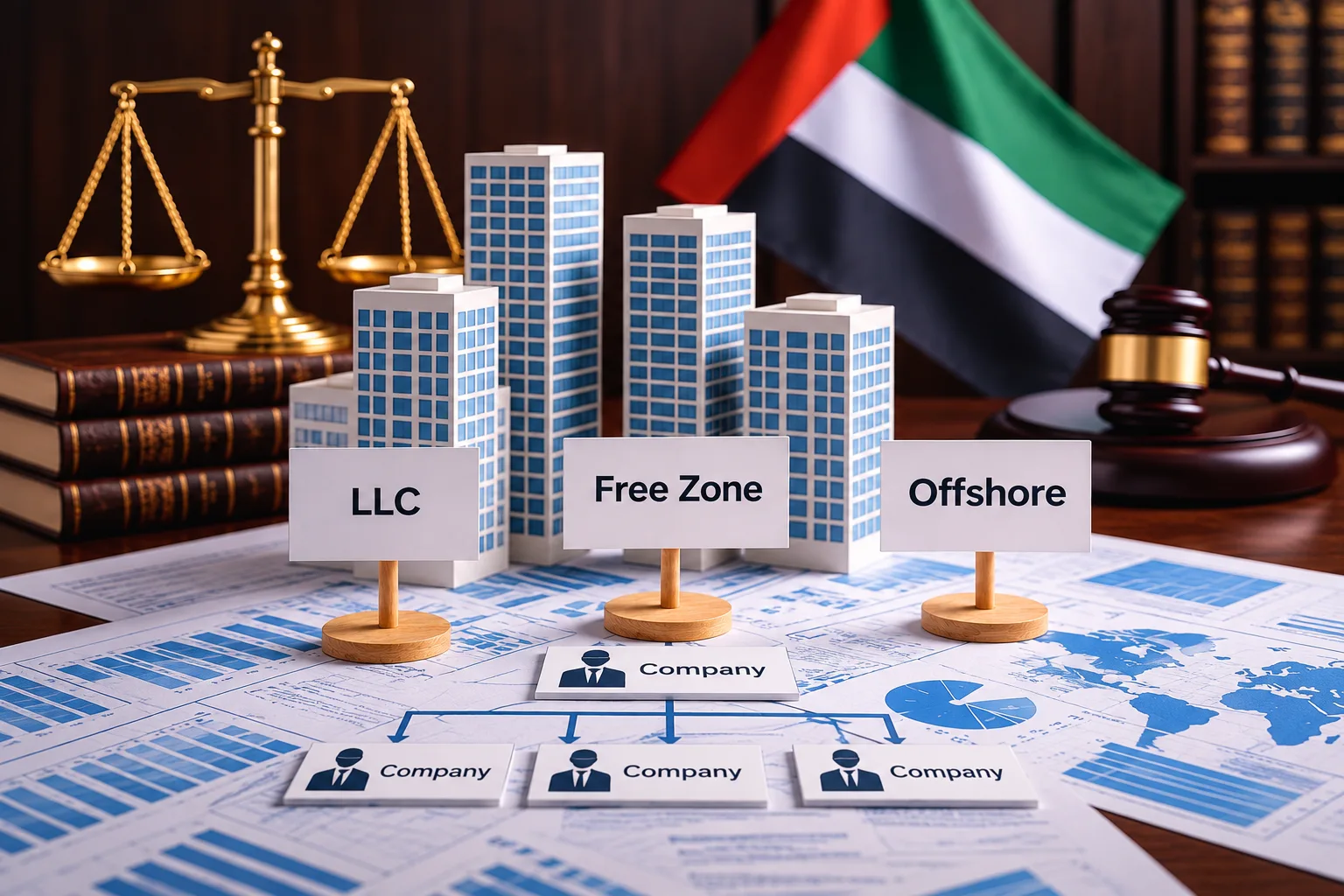
Starting a company in the UAE involves several important decisions. One of the first is choosing the right legal structure for your business.
Should you establish a Limited Liability Company (LLC), register as a sole establishment or set up a company in a free zone? What if you already own a business overseas and want to expand into Dubai?
Each option comes with different rules for ownership, liability, management and business operations. Your choice affects how much personal financial risk you take, who can invest in your company and how easily you can expand in the future. It can also influence licensing requirements, banking arrangements and ongoing compliance costs.
The UAE offers several business structures to accommodate individual entrepreneurs, small businesses, multinational companies and investors.
This guide explains the main UAE legal company structures, their advantages, limitations and the factors you should consider before registering your business.
Understanding the Legal Framework for Companies in the UAE
The primary federal legislation governing commercial companies in the UAE is Federal Decree-Law No. 32 of 2021 on Commercial Companies, as amended.
The law covers important matters such as company formation, shareholder rights, management responsibilities, corporate governance and restructuring.
An important development came through Federal Decree-Law No. 20 of 2025, which amended provisions of the Commercial Companies Law, including rules concerning share classes, company conversions and corporate restructuring.
However, the rules are not identical across every business jurisdiction.
The UAE has three broad company establishment options:
Mainland: Businesses licensed by the relevant emirate's economic authority, generally suitable for direct operations across the UAE.
Free Zone: Companies registered under designated free zone authorities, with their own licensing and company regulations.
Offshore: Structures used mainly for activities such as international business, asset holding and investment ownership, subject to their jurisdiction's rules.
It is important to understand that mainland, free zone and offshore are jurisdictions or establishment categories, while LLCs, partnerships and branches are legal forms.
Your business must choose a suitable combination of jurisdiction, legal form and licensed activity.
For a closer comparison, read Nexture's guide to Dubai mainland vs free zone business setup.
In a 30-minute call we map your situation against jurisdiction, activity and cost — no commitment required.
Types of Legal Company Structures in the UAE
The appropriate structure depends on your business activities, number of shareholders, investment plans and risk exposure.
- Limited Liability Company (LLC)
A Limited Liability Company is one of the most widely used legal structures for businesses operating on the UAE mainland.
An LLC has a legal identity separate from its shareholders. Generally, shareholders are responsible for company liabilities only up to their agreed capital contributions, subject to applicable legal exceptions.
Under the current framework, an LLC can have a single owner or multiple shareholders, within the statutory limit.
Key advantages:
Limited liability protection for shareholders.
Eligibility for 100% foreign ownership in many business activities.
Suitable for commercial, industrial and professional operations where permitted.
Flexible management and shareholding arrangements.
Ability to carry out approved mainland business activities.
For example, an entrepreneur planning to establish a trading company in Dubai may choose a mainland LLC to supply retailers, sign contracts and operate directly in the local market.
However, certain strategically important or regulated activities may involve additional ownership conditions or approvals.
An LLC also has ongoing responsibilities, including maintaining statutory records, renewing its licence and complying with applicable tax obligations.
You can explore the registration process in Nexture's LLC company setup in Dubai guide.
- Sole Establishment
A sole establishment is a business owned by one individual.
Unlike an LLC, an ordinary sole establishment does not have a separate legal personality from its owner. The owner is generally personally responsible for the business's financial obligations. This makes it relatively straightforward to manage but potentially riskier.
Key advantages:
Single-person ownership and decision-making.
A comparatively simple ownership arrangement.
Suitable for certain professional and individual business activities.
No requirement to divide profits among shareholders.
For example, an independent professional offering eligible consulting services may consider a sole establishment.
However, if the business incurs substantial debts or faces legal claims, the owner's personal assets may be exposed.
Foreign ownership eligibility and any local service agent requirements depend on the activity, emirate and applicable rules.
A sole establishment and a single-shareholder LLC are different structures. The latter generally provides a separate corporate legal identity.
- Civil Company
A civil company is commonly associated with professional services carried out by qualified individuals.
Depending on local rules, this structure may be available for activities involving professional expertise, such as consultancy and certain regulated occupations.
Its main characteristics include professional ownership arrangements, activity-specific licensing and the liability rules applicable to its legal form.
For example, qualified professionals planning to establish a professional practice together may examine whether a civil company is permitted for their activity.
Civil companies should not automatically be treated as limited liability entities. Owners should check the applicable rules before registration.
- General Partnership
A general partnership involves partners operating a business together under a recognised partnership structure.
Under the federal Commercial Companies Law, this structure is subject to particular eligibility rules, including restrictions on who may be a partner.
Partners generally have joint and unlimited liability for the partnership's obligations. This means a creditor may be able to pursue the personal assets of partners for qualifying partnership debts.
A general partnership can provide shared management and direct partner involvement. However, its liability exposure makes it less attractive for many investors seeking personal asset protection.
Before choosing this form, partners should have clear agreements covering management responsibilities, profit distribution and dispute resolution.
- Limited Partnership
A limited partnership typically contains two categories of partners.
General partners manage the business and bear unlimited liability for its obligations. Limited partners contribute capital, with liability generally restricted to their contributions, provided they comply with the applicable restrictions on their role.
For example, an eligible operating partner may manage the business while other investors provide financing as limited partners.
The arrangement can separate operational responsibility from passive investment. However, ownership eligibility, management restrictions and partnership liability must be examined carefully.
Both general and limited partnerships are among the legal forms recognised under the UAE Commercial Companies Law.
- Private Joint Stock Company (PrJSC)
A Private Joint Stock Company has capital divided into shares and is commonly considered for businesses requiring a more formal corporate structure.
It may suit established companies planning significant investment, expansion or structured shareholding arrangements.
Its benefits can include a defined share capital structure, formal governance arrangements and opportunities for private investment.
However, formation requirements are more demanding than those of a typical LLC. Statutory capital conditions, shareholder eligibility and regulatory approvals must be reviewed.
The 2025 amendments to the Commercial Companies Law introduced further flexibility concerning certain share arrangements and corporate transactions. The applicable provisions should be checked when planning a new company or restructuring an existing one.
- Public Joint Stock Company (PJSC)
A Public Joint Stock Company is generally intended for larger businesses seeking to raise capital through public investment. Its defining features include a share-based capital structure, formal governance requirements and extensive disclosure and regulatory obligations.
A PJSC may be suitable for a major business planning a public share offering or stock exchange listing, subject to the relevant approvals.
For most small businesses and early-stage entrepreneurs, an LLC is generally a more practical option because a PJSC involves substantially greater regulatory and administrative requirements.
- Branch of a Foreign Company
An overseas company can establish a UAE presence through a branch instead of incorporating a separate subsidiary.
A foreign branch operates as an extension of its parent company. It does not have independent legal personality. For example, an engineering company registered in Germany may open a Dubai branch to serve UAE clients under approved activities. The parent company retains ownership and responsibility for the branch's obligations.
This structure can be useful when an established international business wants direct operational control without creating a separate shareholder-owned subsidiary. Registration usually involves the relevant local licensing authority and the Ministry of Economy and Tourism.
Read Nexture's detailed guide on foreign branch office registration in the UAE.
- Free Zone Company (FZE, FZCO or FZ-LLC)
Free zone companies operate under the regulations of their respective free zone authorities.
Depending on the jurisdiction, they may be registered as:
Free Zone Establishment (FZE): Generally a single-shareholder entity.
Free Zone Company (FZCO): A company structure that can accommodate multiple shareholders, subject to the relevant authority's rules.
Free Zone Limited Liability Company (FZ-LLC): A limited liability entity available in certain free zones.
These structures are popular among entrepreneurs running international trading, technology, consulting and e-commerce businesses. They commonly offer full foreign ownership, simplified establishment procedures and flexible workspace arrangements.
However, a free zone licence does not automatically permit unrestricted business operations on the UAE mainland.
Also, free zone companies are not automatically exempt from corporate tax.
Under the Federal Tax Authority's free zone tax guidance, a Qualifying Free Zone Person may benefit from a 0% corporate tax rate on qualifying income, subject to specific conditions.
- Offshore Company
An offshore company is generally used for international business arrangements, investment holding or asset ownership rather than ordinary mainland trading.
Jurisdictions such as RAK International Corporate Centre and JAFZA Offshore provide specific offshore incorporation frameworks.
These structures may be suitable for holding shares in international companies, managing investments or organising cross-border ownership.
However, offshore companies face restrictions on local commercial activities and access to residence visas. Their tax treatment depends on the applicable laws and circumstances.
An offshore company should not be confused with a free zone trading company.
UAE Legal Company Structures: Comparison Table
Legal structure | Liability | Common suitability |
LLC | Generally limited | Trading, services and SMEs |
Sole Establishment | Personal liability | Individual entrepreneurs |
Civil Company | Depends on applicable rules | Professional practices |
General Partnership | Unlimited partner liability | Eligible partner-managed businesses |
Limited Partnership | Varies by partner category | Structured partnerships |
Private Joint Stock | Generally limited | Established private businesses |
Public Joint Stock | Generally limited | Large businesses raising public capital |
Foreign Branch | Parent company responsible | Overseas company expansion |
FZE/FZCO/FZ-LLC | Generally limited | Free zone operations |
Offshore Company | Depends on incorporation rules | Holding and international activities |
How to Choose the Right Legal Structure in the UAE
There is no single structure that works for every company. Before making your decision, consider five practical questions.
- Where will your customers be located?
If you plan to sell directly to customers across the UAE, a mainland company may be suitable. If your business primarily serves international clients, a free zone may offer an efficient setup.
- How much personal liability are you comfortable accepting?
An LLC generally separates shareholder liability from company obligations. A sole establishment does not provide the same protection.
- Will you have investors or business partners?
Think about future share transfers, investment rounds and ownership changes. Your legal structure should accommodate your long-term plans.
- What are your actual setup and operating costs?
Compare the total expenses, including licensing, office rental, immigration arrangements, renewals and compliance.
For example, a company requiring five employee visas and a physical office may have very different expenses from a single-person consultancy using an eligible flexible workspace.
- Does your activity require additional approval?
Healthcare, education, financial services and certain other activities may require approvals from specialist regulators.
Can You Change Your UAE Company Structure Later?
Yes. Certain company structures can be converted or reorganised under the applicable legislation. The 2025 amendments introduced additional provisions concerning company conversions and transfers between jurisdictions.
However, changing your structure may involve shareholder resolutions, regulatory approvals, amendments to incorporation documents and updates to banking and tax records.
If your business is considering a change of jurisdiction, Nexture's guide on moving a free zone company to Dubai mainland explains the main options.
Choosing a structure that supports your plans can help avoid unnecessary restructuring expenses.
We’ll model the requirements and send back a single-page breakdown within 24 hours.
How Nexture Can Help You Choose the Right Company Structure
Selecting a company structure involves more than completing a registration application. You need to consider ownership, permitted activities, regulatory obligations and future business requirements.
Nexture Corporate Services helps entrepreneurs and investors assess their UAE business setup options. Whether you are considering a mainland LLC, free zone company or foreign branch, Nexture can assist with understanding the relevant licensing procedures, documentation and government approvals.
The objective is to establish a business structure that suits your operations today while allowing room for future growth.
Conclusion
The right legal structure affects how your UAE business operates, manages liabilities and accommodates future investors.
For many entrepreneurs, an LLC offers a practical combination of flexibility and liability protection. A free zone company may suit internationally focused businesses, while a branch can help an established foreign company expand into the UAE.
Before registering, evaluate your activities, ownership requirements, liabilities and long-term plans. Making an informed decision at the beginning can save you considerable time and expense later.
Frequently Asked Questions
What is the most common legal company structure in the UAE?
The Limited Liability Company (LLC) is among the most commonly used structures, particularly for mainland commercial and service businesses.
Can a foreigner own 100% of a UAE company?
Yes. Full foreign ownership is permitted for many mainland activities and is generally available in free zones. Certain regulated or strategically important activities may have additional restrictions.
What is the difference between an LLC and a sole establishment?
An LLC generally provides a separate legal identity and limited shareholder liability. A sole establishment is owned by an individual who is generally personally responsible for business obligations.
Which UAE company structure is best for startups?
A mainland LLC or free zone limited liability company may suit a startup, depending on its activities, customer base, investment plans and operational needs.
Can a free zone company conduct business on the mainland?
Yes, subject to obtaining the appropriate mainland licence, permit or other legally permitted arrangement. A free zone licence alone does not provide unrestricted mainland trading rights.
Are offshore companies exempt from UAE corporate tax?
Not automatically. Offshore incorporation does not, by itself, establish a corporate tax exemption. The company's tax position depends on its circumstances and applicable UAE tax legislation.