Hamriyah Free Zone Authority (HFZA) is one of the UAE's largest and most established industrial free zones, located in Sharjah with direct access to Hamriyah Port, major road networks, and 360-degree connectivity. HFZA offers 100% foreign ownership, six specialized business sectors, flexible facility options, and a streamlined setup process. It suits manufacturers, oil and gas companies, maritime businesses, food producers, and logistics operators looking for a serious industrial base in the UAE.
Most people researching UAE free zones start with Dubai. That's understandable. But if your business involves heavy industry, manufacturing, oil and gas, maritime operations, or large-scale logistics, HFZA deserves your full attention before you make any decisions.
This guide covers everything you need to know about HFZA business setup in 2025: what the zone offers, which sectors it supports, how licenses work, what facilities are available, how the setup process runs step by step, what it costs, and who actually benefits from choosing it.
What Is HFZA and Where Is It Located?
HFZA stands for Hamriyah Free Zone Authority. The zone was established by the Government of Sharjah in 1995 and operates under its own regulatory authority within the UAE's broader free zone framework.
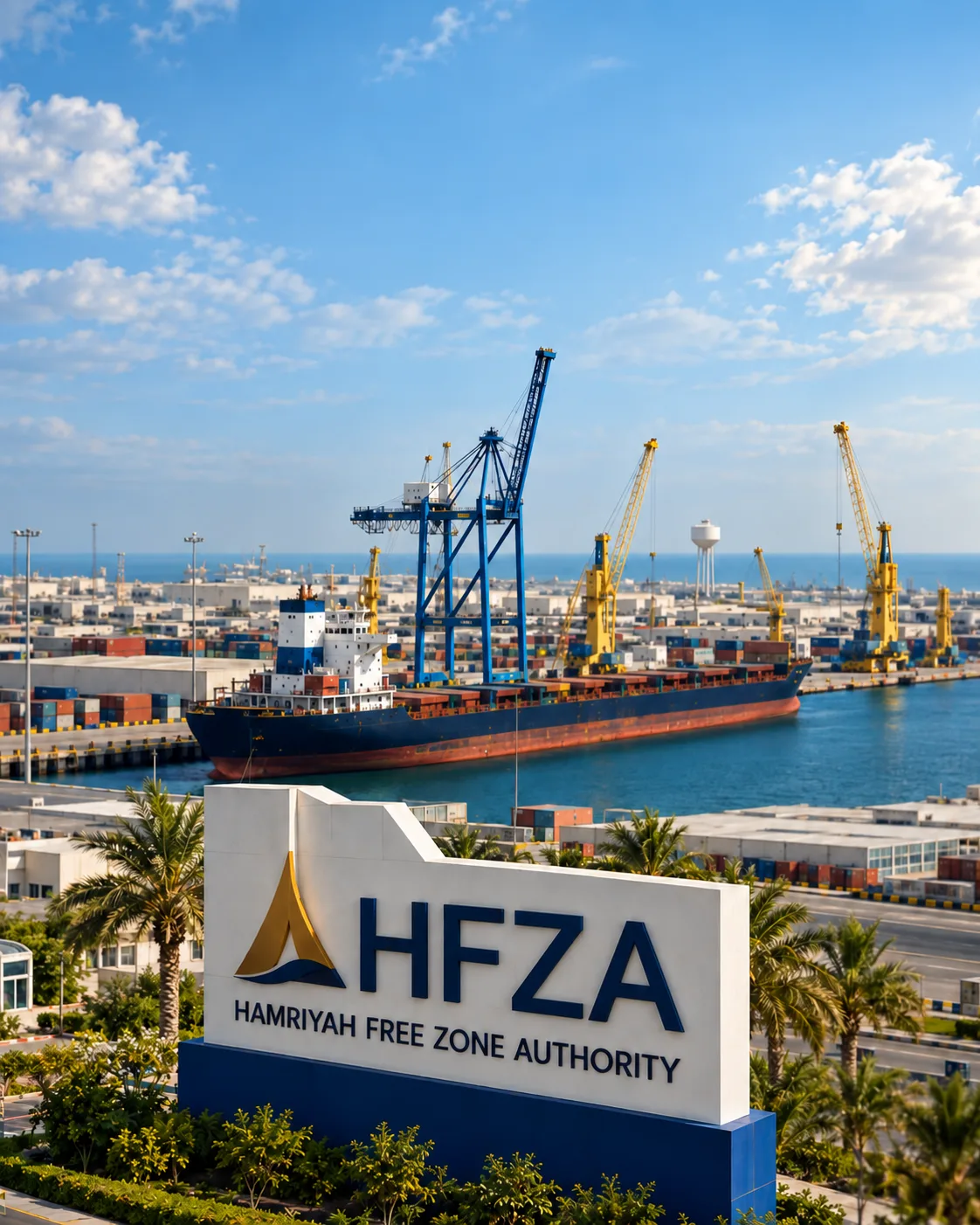
The zone is located in the Hamriyah area of Sharjah, positioned along the UAE's western coastline. Its location gives businesses direct access to Hamriyah Port, which handles a significant volume of cargo including bulk commodities, containers, and industrial equipment. Road access connects the zone to Dubai in under 30 minutes and to Sharjah's main commercial areas within minutes.
According to hfza.ae, HFZA is the second-largest industrial free zone in the UAE. Its scale is not incidental. The zone was purpose-built to accommodate businesses that need substantial physical space, heavy infrastructure, and reliable port access. That's a different profile from the typical free zone, and it's an important distinction when you're evaluating your options.
Companies registered in HFZA benefit from the same UAE-wide legal protections, banking infrastructure, and national regulatory standards as any other licensed entity in the country, with the additional benefits that free zone status provides.
In a 30-minute call we map your situation against jurisdiction, activity and cost — no commitment required.
What Are the Key Benefits of Setting Up a Business in HFZA?
100% foreign ownership. You retain full control of your business. No UAE national partner or local sponsor is required. This applies to all registered companies regardless of the investor's nationality.
Full profit and capital repatriation. There are no restrictions on transferring profits out of the UAE. No currency controls, no repatriation limits.
Zero customs duties. Goods imported into and exported from the free zone are not subject to UAE customs duties. For manufacturing and trading businesses managing cross-border supply chains, this is a direct cost saving.
Corporate tax advantages. Free zone companies in the UAE can qualify for a 0% corporate tax rate on qualifying income under the UAE Corporate Tax Law introduced in 2023. Whether your business qualifies depends on your activity type and structure, so confirm this with a qualified tax advisor.
Port-adjacent operations. Hamriyah Port sits right on the zone's boundary. If your business depends on moving bulk cargo, industrial equipment, or large volumes of goods, this proximity is a genuine operational advantage. Port handling, customs clearance, and freight logistics are all accessible from within the zone.
Large-scale infrastructure. HFZA offers industrial land, pre-built warehouses, factory units, and executive offices. The zone can accommodate businesses at every stage, from a startup in a small office to a heavy manufacturer on a multi-hectare industrial plot.
Specialized sector support. HFZA organizes its business community into six distinct sectors, each with dedicated infrastructure and support. This sector-specific approach is a real differentiator from most other UAE free zones.
Award-winning zone. HFZA ranked 2nd globally as the Best Free Zone in 2024 and won the Global Free Zone of the Year Award in 2022. These are independently assessed rankings, not self-reported claims.
For a broader comparison of what different UAE free zones cost and offer, this Dubai free zone company setup cost breakdown gives you a useful reference point when building your shortlist.
What Business Sectors Does HFZA Support?
Which industries and business activities can operate in HFZA?
HFZA organizes its investors into six specialized sectors. Each comes with dedicated infrastructure, applicable license types, and relevant support services.
Industrial Manufacturing Park. This is the zone's largest sector. It covers light and heavy manufacturing, processing, and assembly operations. Businesses here have access to factory units, industrial land, and utilities infrastructure suited to production-scale operations.
Global Logistics Park. Designed for freight forwarding, warehousing, distribution, and supply chain businesses. Given HFZA's proximity to Hamriyah Port and major road networks, logistics companies here benefit from genuine multimodal access.
Oil and Gas. HFZA has dedicated facilities for businesses in the oil, gas, and energy sector. This includes companies involved in equipment supply, maintenance, fabrication, and related services. The sector has attracted established names like Dana Gas and Halliburton.
Maritime Industry. Covers marine services, ship repair, offshore support, and related maritime businesses. The port location makes HFZA a practical base for companies in this space.
Food Park. A dedicated zone for food processing, packaging, and storage businesses. The food park has separate infrastructure designed to meet food safety and hygiene standards.
Accelerator Hub. Aimed at startups, SMEs, and technology-focused businesses that need a cost-effective entry point into the UAE market. This sector has smaller office and workspace options suitable for early-stage companies.
Understanding which sector fits your business activity is step one in any HFZA setup process. The sector determines which facilities and license types apply to you. If you're weighing up whether a free zone structure or a UAE mainland license makes more sense for your specific situation, this Dubai mainland vs freezone business setup guide covers the key trade-offs clearly.
What License Types Are Available in HFZA?
HFZA issues several categories of business licenses depending on your activity.
Trading License. Covers import, export, distribution, and re-export of goods. Suitable for businesses that move products rather than manufacture them.
Industrial License. For manufacturing, processing, and assembly operations. This is the most common license type in HFZA given the zone's industrial orientation.
Service License. For professional, consultancy, and service-based businesses. Available primarily through the Accelerator Hub sector for companies not engaged in physical goods.
Commercial License. Covers general commercial activities including buying, selling, and distributing goods within the free zone framework.
The UAE government's free zones information portal provides a broader overview of how UAE free zone licensing works and what companies operating within them are permitted to do.
What Facilities and Infrastructure Does HFZA Offer?
HFZA's infrastructure is one of its clearest strengths. The scale and variety of facilities available sets it apart from smaller, more office-centric free zones.
Executive Offices. Private, fitted office units at Hamriyah Business Centre. These suit professional services companies, regional headquarters, and businesses that need a formal office presence without warehouse or industrial requirements.
Flexi-Desks and Shared Workspaces. Entry-level workspace with a registered free zone address. These are available primarily through the Accelerator Hub sector. Visa quota under a flexi-desk arrangement is typically limited.
Pre-Built Warehouses. International-standard prefabricated warehouse units available in varying sizes. These suit trading, distribution, and light industrial businesses. The warehouses are built to operational standards and can be customized to specific requirements.
Factory Units. Dedicated industrial facilities for manufacturing and processing operations. These include utilities connections and are designed for full production use.
Industrial Land Plots. HFZA makes land available for companies that need to construct their own facilities. Plots are offered on long-term lease arrangements within the 30 million square meter zone. New industrial plots are currently available according to the official HFZA website.
Beyond physical space, HFZA provides support services including customs clearance access, freight logistics coordination, telecommunications infrastructure, and business support through the free zone authority offices.
How Do You Set Up a Company in HFZA Step by Step?
The setup process is structured and relatively straightforward. Here is how it works in practice.
Step 1: Identify your business activity and sector.
Before you fill in any forms, get precise about what your company will do. Vague descriptions cause problems at the licensing stage and at the bank. Match your activities to the right HFZA sector first, then confirm the specific activity codes with the authority.
Step 2: Choose your facility type.
Your choice of office, warehouse, factory, or land plot determines your visa quota and your annual costs. If you expect to hire several employees in the first year, factor visa capacity into your facility decision now rather than paying for an upgrade later.
Step 3: Prepare your documentation.
Standard requirements for an HFZA application include:
Passport copies for all shareholders and directors
Passport-size photographs
Completed application form from the authority
Business plan (required for certain activity types and sectors)
If you currently hold a UAE residence visa sponsored by an employer, you may need a No Objection Certificate before proceeding.
Step 4: Submit your application and pay fees.
Once HFZA approves your application, you pay the license and facility fees. HFZA then issues your trade license, memorandum of association, and share certificate. Processing timelines vary but are typically within a few working days for straightforward applications.
Step 5: Obtain your establishment card.
This document authorizes your company to sponsor residence visas. You cannot hire employees or sponsor dependents without it. It costs approximately AED 2,000 to AED 3,000 and requires annual renewal.
Step 6: Apply for investor and employee visas.
With the establishment card in hand, you can begin visa processing. Each visa involves a medical fitness test, Emirates ID application, and entry permit processing. Allow two to three weeks per visa from complete document submission.
Step 7: Open a corporate bank account.
Start this process in parallel with visa processing where possible. Banks require your trade license, MOA, share certificate, and shareholder passport copies. Some banks also ask for a detailed business plan and evidence of expected transaction volumes. Allow four to eight weeks for approval. Emirates NBD, Mashreq, and Sharjah Islamic Bank are commonly used by free zone companies in the Sharjah area.
Much of the setup process can be initiated remotely. As covered in this guide on starting a UAE business as a non-resident, free zone applications are largely handled digitally. Physical presence is typically required for visa stamping and bank account opening only.
We’ll model the requirements and send back a single-page breakdown within 24 hours.
How Much Does HFZA Business Setup Cost?
HFZA's cost structure reflects its industrial orientation. Entry-level costs are competitive for what you get, but industrial and land-based setups carry significantly higher fees than a standard office free zone.
License fees for a basic service or commercial license in the Accelerator Hub sector start from approximately AED 10,000 to AED 15,000 per year. Industrial licenses typically run higher depending on the activity and sector.
Flexi-desk packages bundled with an Accelerator Hub license typically start from around AED 15,000 to AED 22,000 for the first year before visa costs.
Visa processing adds approximately AED 3,500 to AED 5,000 per person, covering the medical test, Emirates ID, and entry permit fees.
Establishment card costs AED 2,000 to AED 3,000 annually and must be renewed each year.
Warehouse units are priced by size and start from approximately AED 30,000 per year for smaller units. Larger units and customized configurations cost more.
Industrial land plots are priced separately based on size and lease terms. These are negotiated directly with the HFZA authority for businesses requiring significant land areas.
A basic single-visa setup in the Accelerator Hub (flexi-desk, service license, one investor visa) typically comes to approximately AED 20,000 to AED 28,000 for the first year. An industrial setup with a warehouse and two or three visas will generally run AED 50,000 to AED 80,000 or more depending on the unit size.
Renewal costs matter. License renewals are typically 80 to 90 percent of the original fee. Budget for them from the start. Annual renewal surprises are one of the most common reasons businesses underestimate their UAE operating costs in year two. For a structured comparison across UAE free zones, this complete breakdown of Dubai free zone setup costs gives a useful framework.
Conclusion
HFZA offers something that most UAE free zones cannot: genuine industrial infrastructure at scale, combined with the standard free zone benefits of full foreign ownership and tax efficiency. For manufacturing, oil and gas, maritime, food processing, and logistics businesses, it's one of the most practical and well-resourced options in the UAE.
The setup process is straightforward, but the details matter. Choosing the wrong sector, listing inaccurate activity codes, or misjudging your facility requirements can create costly complications down the line. Getting the initial structure right is far easier than correcting it later.
Frequently Asked Questions
What is HFZA and where is it located?
Hamriyah Free Zone Authority (HFZA) is a UAE free zone established in 1995 by Emiri Decree in the Emirate of Sharjah. It spans 30 million square meters and sits adjacent to Hamriyah Port, with direct road connections to Dubai and the northern emirates. HFZA is the second-largest industrial free zone in the UAE and hosts investors from over 160 countries.
How much does HFZA company setup cost in 2025?
A basic Accelerator Hub setup with a flexi-desk and one investor visa typically costs AED 20,000 to AED 28,000 for the first year. Warehouse-based setups with two or three visas generally run AED 50,000 to AED 80,000 depending on unit size. Industrial land configurations are priced separately based on plot size and lease terms.
Can a foreigner own 100% of an HFZA company?
Yes. HFZA allows 100% foreign ownership for all registered companies. No UAE national partner or local sponsor is required.
What business sectors does HFZA support?
HFZA operates across six sectors: Industrial Manufacturing Park, Global Logistics Park, Oil and Gas, Maritime Industry, Food Park, and Accelerator Hub. Each sector has dedicated infrastructure and applicable license types.
What license types does HFZA offer?
HFZA issues trading, industrial, service, and commercial licenses. The right license depends on what your company actually does. Industrial licenses are the most common given the zone's orientation toward manufacturing and heavy industry.
How long does HFZA company registration take?
Once you submit complete documents and pay fees, HFZA typically issues your trade license within a few working days. Visa processing adds two to three weeks per applicant. Bank account opening can take four to eight weeks depending on your bank and business activity profile.