

A tax audit notice can be stressful, but it does not automatically mean the Federal Tax Authority has found serious wrongdoing. The FTA conducts audits to check whether businesses have registered correctly, filed accurate returns, paid the right tax and maintained proper records.
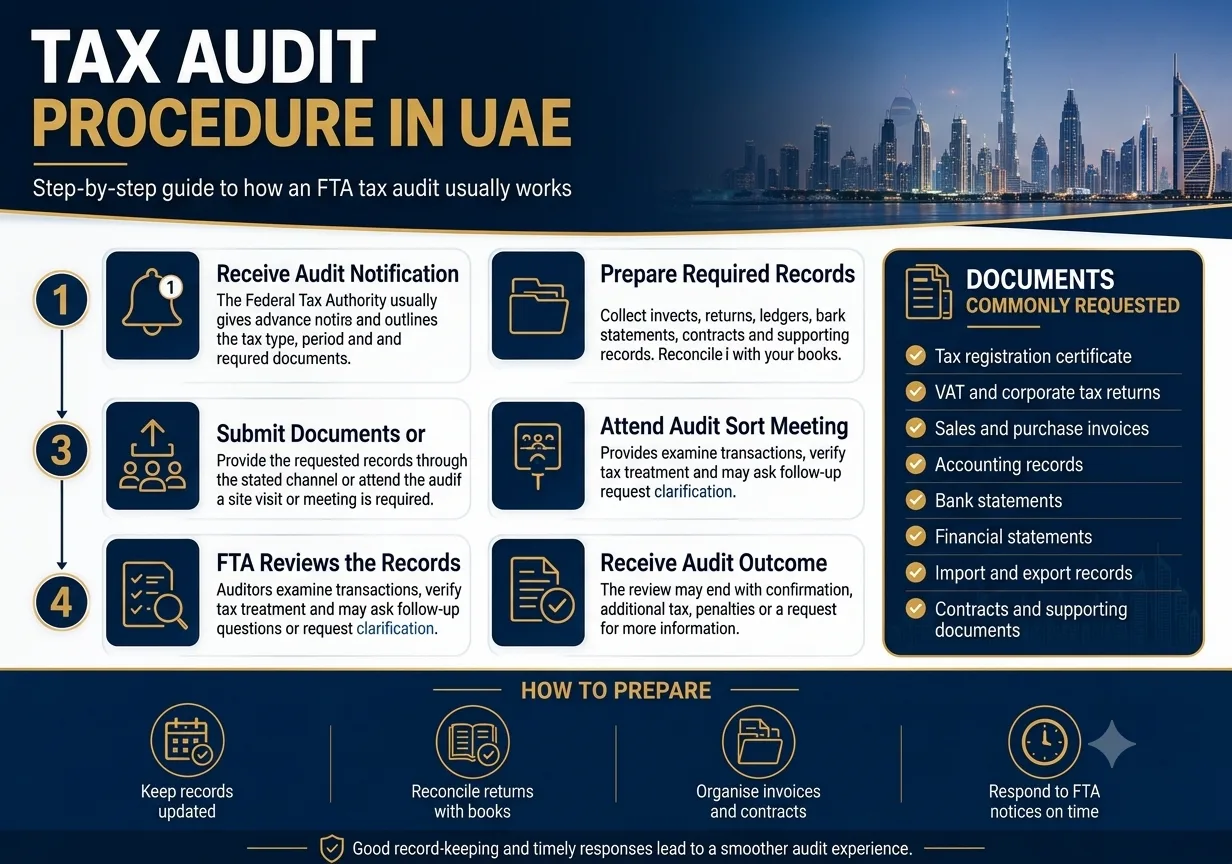
A tax audit UAE review may cover VAT, corporate tax, excise tax or other obligations. It can involve a request for documents, an inspection of accounting systems or a visit to your business premises.
The easiest way to handle an audit is to stay prepared before any notice arrives. Your returns should match your books and every important transaction should have reliable supporting evidence.
Key Takeaways
The FTA has the legal authority to audit any person to verify tax compliance.
Businesses normally receive at least 10 business days’ notice before an audit.
Auditors may inspect documents, electronic data, accounting software, assets and business premises.
General tax records must usually be kept for at least five years while corporate tax records must generally be retained for seven years.
Missing records and failure to cooperate with an auditor can lead to administrative penalties.
Regular internal reviews make it easier to correct mistakes before they become serious audit issues.
In a 30-minute call we map your situation against jurisdiction, activity and cost — no commitment required.
What Is a Tax Audit in UAE?
A UAE tax audit is an official review conducted by the Federal Tax Authority. Its purpose is to confirm whether a person or business has complied with the UAE Tax Procedures Law and the relevant tax legislation.
The FTA may compare your tax returns with:
Sales and purchase invoices
Accounting ledgers
Bank transactions
Financial statements
Customs records
Contracts
Electronic accounting data
Under the UAE Tax Procedures Law, the FTA can audit any person when it needs to verify tax compliance. The audit may take place at an FTA office, your business premises or another location where records are kept.
Tax area | Records commonly reviewed | Typical concerns |
VAT | Invoices, VAT returns, credit notes and import records | Incorrect input tax claims, wrong tax rates and missing invoices |
Corporate tax | Financial statements, ledgers, asset records and tax calculations | Unsupported expenses, incorrect adjustments and free zone tax treatment |
Excise tax | Import data, stock records and warehouse reports | Undeclared goods and incorrect stock reporting |
General compliance | Registration details, returns, payments and correspondence | Late registration, inaccurate records and missed deadlines |
Businesses should also review the latest FTA VAT guidance and corporate tax guides that apply to their activities.
Who Can Be Selected for a UAE Tax Audit?
Any person with UAE tax obligations can be selected. This includes registered taxpayers and businesses that should have registered but failed to do so.
The FTA may audit:
VAT-registered businesses
Corporate tax-registered businesses
Excise tax registrants
Mainland companies
Free zone companies
Branches of foreign companies
Tax groups
Sole establishments
Taxable natural persons
Free zone companies are not automatically outside the tax system. They may still need to register for corporate tax, file returns and keep evidence supporting any claim for the 0% rate on qualifying income.
Your legal structure also affects your records and tax responsibilities. Business owners can review Nexture’s guides on forming a limited liability company in Dubai and comparing an LLP and LLC in the UAE.
The FTA does not publish its full audit selection formula. However, inconsistent filings, repeated corrections, large refund claims, unexplained turnover changes and missing records may attract closer attention.
Why Does the FTA Conduct Tax Audits?
The FTA conducts audits to confirm that reported figures match the underlying business records.
An FTA tax audit may be used to:
Verify tax return accuracy
Confirm that tax was calculated and paid correctly
Check input VAT claims
Review zero-rated and exempt transactions
Identify unreported income or taxable supplies
Examine corporate tax deductions
Confirm free zone or exemption eligibility
Review import and export transactions
Check related-party dealings
Verify registration information
For example, if your accounting records show AED 1 million in sales but your VAT returns report AED 900,000, the FTA may ask for an explanation. The difference could be caused by exempt income, timing adjustments or a filing error. You must be able to prove the reason.
Documents Required for a Tax Audit in UAE
The exact documents depend on the tax type, audit period and business activity. The audit notice will normally explain what must be submitted.
Common records include:
Document category | Examples |
Registration documents | Tax registration certificate, trade licence and incorporation documents |
Tax filings | VAT returns, corporate tax returns, excise returns and voluntary disclosures |
Sales records | Tax invoices, contracts, credit notes and delivery documents |
Purchase records | Supplier invoices, payment proof and expense approvals |
Accounting records | General ledger, trial balance, journals and chart of accounts |
Financial records | Bank statements, financial statements and management accounts |
Trade records | Customs declarations, shipping documents and import or export records |
Supporting records | Payroll, fixed asset register, inventory records and related-party agreements |
How Long Should Tax Records Be Kept?
General tax records must normally be kept for at least five years after the relevant tax period. Corporate tax records generally need to be retained for seven years.
Longer periods may apply during an active audit, tax dispute or where the FTA extends the retention requirement under the law.
Electronic records are acceptable when they remain complete, readable and capable of being reproduced. The FTA may also request an approved Arabic translation of documents.
Tax Audit Procedure in UAE
The UAE tax audit process usually follows five stages.
- Receive Audit Notification
The FTA generally gives at least 10 business days’ notice before conducting a tax audit.
The notice should state:
The tax type being reviewed
The audit period
The records required
The submission deadline
Whether a site visit is planned
The method for providing documents
Check your registered email, mobile number and EmaraTax account regularly. Outdated contact details can cause you to miss an important deadline.
- Prepare Required Records
Create a checklist based on the audit notice and appoint one person to coordinate the response.
Reconcile each tax return with the trial balance, general ledger and supporting documents. For VAT, match reported figures to invoices. For corporate tax, connect the taxable income calculation to the final financial statements and adjustment schedules.
Do not create false records or alter old invoices. If something is missing, explain it honestly and provide alternative evidence such as contracts, bank payments or customs documents.
Businesses that need support with VAT records and tax administration can review Nexture’s corporate tax and VAT services.
- Submit Documents or Attend Audit
The FTA may request digital files or inspect the business premises, assets, accounting system and electronic records.
Use clear folder names and file names. Keep a copy of every file submitted and record the submission date. During a site visit, ensure that the authorised employee or tax representative is available.
- FTA Reviews the Records
The auditor may test selected transactions instead of checking every invoice. High-value sales, unusual expenses, related-party payments and transactions receiving special tax treatment are more likely to receive attention.
Answer questions accurately. If you need time to verify something, say so and provide a checked response within the agreed period. Different employees should not give conflicting explanations.
- Receive Audit Outcome
The FTA should notify the person of the audit result after the review ends.
The result may:
Confirm that no adjustment is required
Identify additional tax payable
Issue a tax assessment
Apply administrative penalties
Request further documents or clarification
Review the decision immediately. If you believe it is incorrect, seek professional advice on the assessment review, reconsideration or tax dispute process before the applicable deadline expires.
We’ll model the requirements and send back a single-page breakdown within 24 hours.
How to Prepare for a UAE Tax Audit
Do not wait for an audit notice before checking your records. Carry out an internal tax review at least once or twice a year.
Reconcile Returns With Accounting Records
Compare VAT returns with the sales ledger, purchase ledger, trial balance and bank records. For corporate tax, reconcile accounting profit with taxable income and document every adjustment.
Any difference should have a clear explanation.
Check Tax Invoices
Review a sample of sales and purchase invoices. Confirm that required details are present, the tax rate is correct and the invoice belongs to the right tax period.
Missing or incorrect invoices can lead to rejected input tax claims and penalties.
Organise Contracts and Evidence
Keep contracts, purchase orders, delivery notes and payment records with the related invoice. These records help prove the business purpose and tax treatment of a transaction.
Businesses in regulated sectors should also organise their licence and compliance documents. Nexture’s real estate broker compliance guide shows how operational and regulatory records can overlap.
Review Past Filing Errors
If you find an incorrect return, determine whether a voluntary disclosure or another correction method is required.
The correct process depends on the tax type, amount and timing. Fixing an error before an audit notice may reduce the risk of a more serious penalty.
Protect Accounting Data
Maintain secure backups and restrict editing rights. Your accounting system should preserve a clear audit trail showing when entries were created or changed.
Use Qualified Support
A registered tax agent may represent a taxable person before the FTA. You can check the official FTA list of registered tax agents.
Nexture also provides wider UAE business and compliance services for companies that need help with registration, licensing and ongoing administration.
Common Tax Audit Mistakes to Avoid
Mistake | Possible result | Practical solution |
Missing invoices | Tax claims may be rejected | Maintain digital copies and request replacements |
Incorrect VAT treatment | Additional VAT and penalties | Check the tax rate and place-of-supply rules |
Poor bookkeeping | Returns cannot be verified | Reconcile accounts every month |
Unreconciled bank statements | Income differences may be questioned | Complete monthly bank reconciliations |
Unsupported expenses | Corporate tax deduction may be denied | Keep invoices, contracts and payment proof |
Ignoring FTA notices | Missed deadlines and penalties | Monitor EmaraTax and registered contact details |
Conflicting explanations | Longer audit review | Appoint one audit coordinator |
Delayed error correction | Higher penalty exposure | Review disclosure requirements quickly |
Administrative penalties may apply for failing to keep required records or failing to facilitate an auditor’s work. These penalties can be added to unpaid tax and other amounts due under the relevant legislation.
Businesses should check the latest UAE Ministry of Finance penalty rules before relying on older penalty figures.
Conclusion
A tax audit in UAE is easier to manage when your returns match your books and each transaction has supporting evidence.
Reconcile accounts every month, review VAT and corporate tax filings regularly and retain documents for the full legal period. If you find an error, address it before an audit notice arrives and use the correct correction process.
For help with UAE company compliance, VAT matters and business administration, contact Nexture Corporate Services.