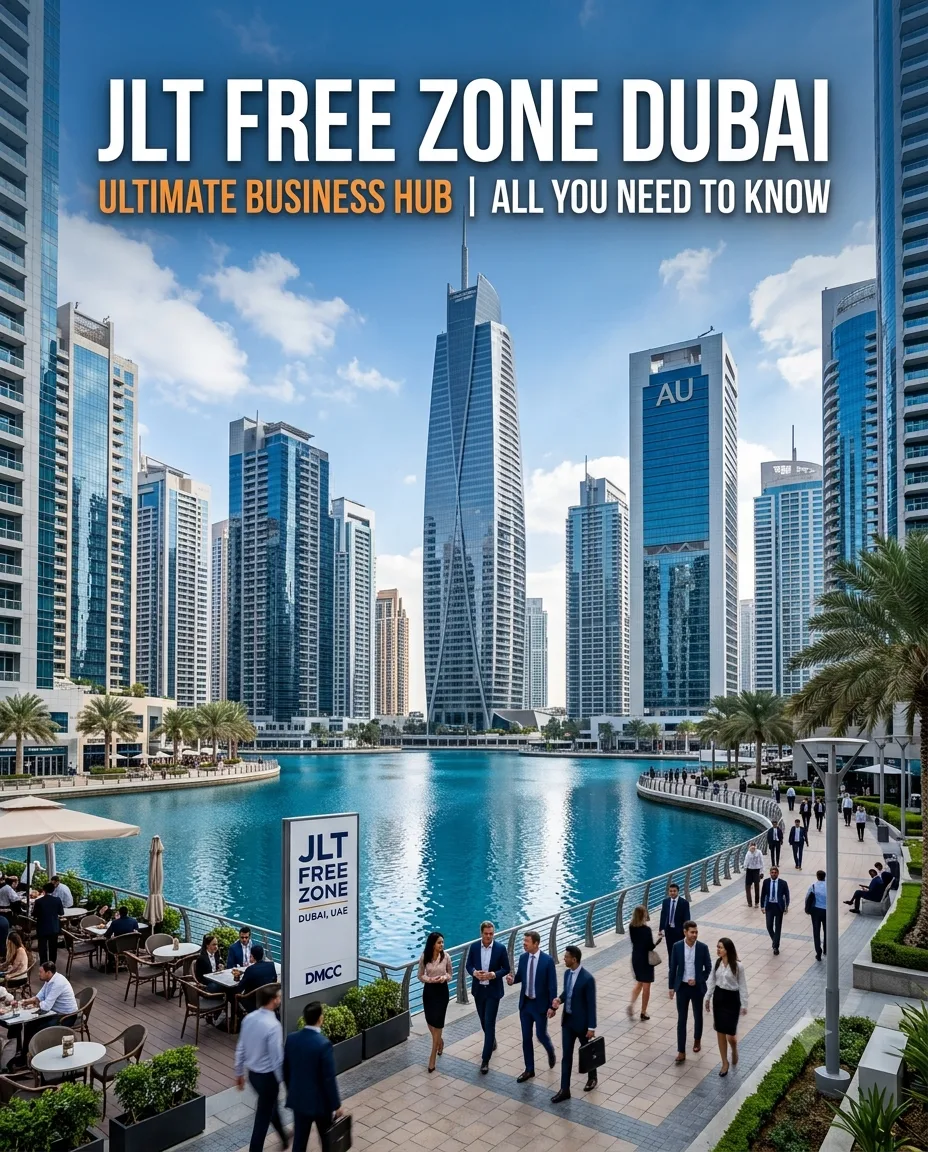
If you've been searching for "JLT free zone," you've probably already run into a small mix-up that trips up a lot of first-time investors. Jumeirah Lakes Towers isn't itself the licensing authority. The free zone that operates inside JLT, issues the licenses, and handles company registration is DMCC, the Dubai Multi Commodities Centre. Once you understand that one detail, the rest of the process becomes much easier to follow.
This guide walks through what DMCC actually offers inside JLT, how the registration process works, what licenses are available, and what you should budget for before you commit.
What Is JLT Free Zone (DMCC), Exactly?
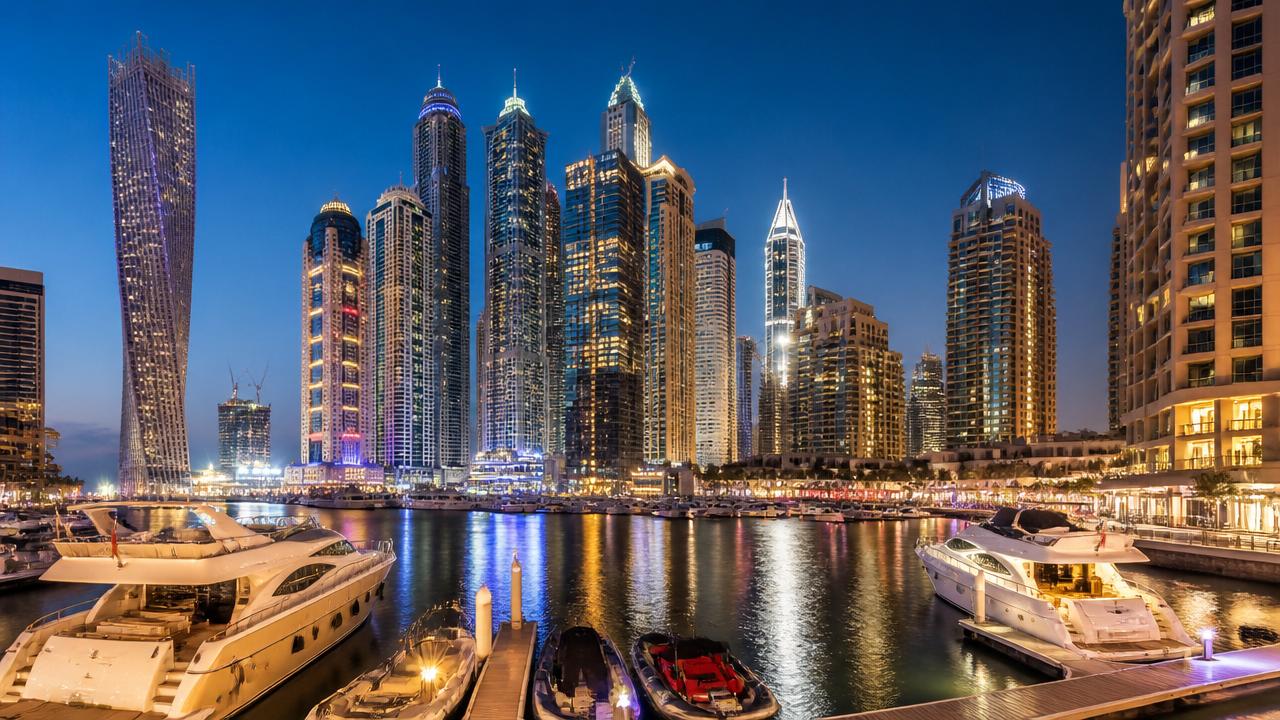
Jumeirah Lakes Towers is a waterfront district sitting opposite Dubai Marina along Sheikh Zayed Road, built around several man-made lakes. The district covers around 200 hectares and is organized into 26 clusters labeled A through Z. The free zone authority housed there, DMCC, was established in 2002 as a Government of Dubai Authority and now supports well over ten thousand registered companies working in commodities trading, technology, financial services, and dozens of other sectors.
So when people say "JLT free zone," they usually mean a DMCC company registered with a JLT address. Your license, your establishment card, and your visa quota all come from DMCC, not from any separate JLT authority.
The location itself is well connected. The DMCC Metro Station sits on the Red Line, giving staff and clients direct access across the city, and the district is a short drive from both Dubai International Airport and Al Maktoum International Airport. For a fuller picture of the neighborhood itself, Bayut's JLT area guide covers the residential clusters, transport links, and day-to-day amenities around the towers.
In a 30-minute call we map your situation against jurisdiction, activity and cost — no commitment required.
License Types Available Through DMCC
DMCC issues several license categories, and picking the right one depends entirely on what your company actually does day to day.
License type | Best suited for |
General Trading License | Trading multiple, unrelated product lines under one license |
Trading License | Trading a defined group of related goods |
Service (Professional) License | Consultancy, advisory, and other service-based activities |
Industrial License | Light manufacturing or processing carried out within the free zone |
Every company must register activities that match its license category, and businesses operating across more than one category typically need a separate license for each. If your activity touches a regulated sector, such as gold and diamonds, crypto-related services, or financial trading, expect an extra layer of approval from the relevant regulator before DMCC issues your license.
Before you commit to a category, it's worth mapping your intended activities against the free zone's approved list. DMCC's own licensing guide sets out the renewal and validity rules attached to each category, and we cover the broader activity-mapping exercise in our step-by-step guide to setting up a business in Dubai, which applies to DMCC as much as any other jurisdiction.
How the Registration Process Works
According to DMCC's own setup guidance, the registration process runs through three stages: submitting an online pre-approval application, completing payment and signing documents through the DMCC portal, and then choosing an office solution that fits your business. Once those steps are clear, DMCC issues your license electronically.
In practice, the sequence looks like this:
Name reservation and initial approval. You submit your application along with a small processing fee, and DMCC reviews the proposed trade name and business activity.
Registration and license fee payment. Once your application clears compliance review, you pay the registration and license fees and sign the incorporation documents.
Office or flexi-desk selection. DMCC requires every registered company to hold a physical business address within the free zone, whether that's a flexi-desk, a serviced office, or leased space.
License issuance. The full process, from application to E-license, typically takes around ten working days once documentation and approvals are complete.
Minimum share capital for a DMCC company sits at roughly USD 13,612, and that amount needs to be deposited into the company's UAE bank account within three weeks of the license date. You can withdraw it afterward, but the deposit itself is a registration requirement, not a permanent lock on funds.
One detail people often miss: according to DMCC's business setup page, licenses come with 1, 2, or 3-year validity options, and choosing a longer term saves money. A 2-year license carries roughly a 5% discount on total license fees, while a 3-year term brings that down by around 10%. If you're confident your business model is stable, a multi-year license can be worth the upfront commitment.
If you're structuring your setup as a non-resident, note that DMCC allows full remote registration in most cases. Ownership rules, visa eligibility, and banking requirements differ slightly for founders who don't plan to relocate immediately, and we break those distinctions down in our guide on starting a business in the UAE as a non-resident.
Office Solutions Inside JLT
DMCC offers a spread of workspace options rather than a single fixed model. A flexi-desk suits a founder who needs a registered address and little else. Serviced offices work for small teams that want a functioning space without a long lease commitment. Larger companies can lease or buy full office floors across the towers in JLT, several of which DMCC itself developed and manages.
Your office choice affects more than comfort. DMCC ties the number of visas you can apply for to the size and type of workspace you hold, so a business planning to hire five or six staff will need to budget for something beyond a flexi-desk from the outset.
Visas and Staffing
Employment visas for DMCC companies run through DMCC's own portal rather than a separate immigration office, which keeps the process contained to one system. Once your establishment card is active, you can apply for investor visas, employee visas, and dependent visas tied to your company.
Getting the paperwork right the first time matters here. Visa rejections or delays usually come down to missing attestations or documents submitted out of sequence, not the underlying eligibility. Our ICP Smart Services guide walks through how the UAE's digital immigration platform handles visa, Emirates ID, and residency applications, which is useful background once your DMCC license is active and you're ready to bring staff on board.
What Setup Actually Costs
There's no single number here, and anyone who quotes you a flat fee without knowing your activity, office choice, and visa count is skipping steps. What you can rely on are rough ranges. First-year setup costs for a DMCC company generally fall somewhere between AED 35,000 and AED 55,000, depending on the license activity, office or flexi-desk type, and visa package chosen. Renewal fees follow a similar logic, moving up or down based on office size and visa allocation rather than a fixed schedule.
A few things worth flagging before you sign anything:
VAT applies to most license and service fees. Always confirm whether a quoted figure is inclusive of the 5% VAT or not before comparing packages.
Share capital is separate from setup fees. Don't confuse the deposit requirement with the money you're paying DMCC for registration.
Regulated activities cost more. Crypto-related, financial, or commodities-trading activities often carry additional regulator fees on top of the standard DMCC schedule.
The UAE government's own free zone business guidance makes the same point: request a written quote rather than relying on advertised figures. Because published fee schedules shift and packages vary by activity, treat any number you see online, including the ranges above, as a starting point rather than a quote. Requesting a written breakdown for your specific activity and structure is the only reliable way to know your actual first-year cost. We handle that costing exercise for clients directly, and you're welcome to get in touch for a tailored figure rather than a generic estimate.
Tax Treatment for DMCC Companies
A DMCC company can qualify for a 0% corporate tax rate on qualifying income under the UAE's Qualifying Free Zone Person rules, but that treatment isn't automatic. You need to meet substance requirements, keep your income within qualifying categories, and stay current on compliance filings. Income that falls outside the qualifying definition, or income earned through mainland dealings that don't meet the free zone conditions, gets taxed at the standard 9% rate above the AED 375,000 threshold. Given how easy it is to misjudge which income qualifies, it's worth getting tax advice specific to your activity rather than assuming the 0% rate applies by default.
We’ll model the requirements and send back a single-page breakdown within 24 hours.
Trading With the Mainland
DMCC companies can also operate on the Dubai mainland through a dual licensing arrangement, which lets a free zone entity extend its activity beyond the free zone under the Department of Economic Development framework. This matters if your business model depends on serving mainland clients directly rather than working through a distributor. Not every activity qualifies for dual licensing, so check this early if mainland access is part of your plan, rather than discovering the restriction after you've already registered.
JLT (DMCC) vs Other Dubai Free Zones
Factor | DMCC (JLT) | JAFZA | Mainland |
Best for | Trading, commodities, services, tech | Logistics, manufacturing, import/export | UAE-wide market access |
Ownership | 100% foreign | 100% foreign | 100% foreign for most activities |
Mainland access | Via dual license | Via dual license | Direct |
Typical setup timeline | Around 10 working days | Similar range | 1 to 6 weeks depending on activity |
Office requirement | Flexi-desk to full floors | Warehouses and offices | Registered office required |
None of these jurisdictions is universally better. A logistics company moving physical goods through Jebel Ali Port has different needs than a consultancy or a trading company working out of JLT. Matching your activity to the right free zone matters more than chasing whichever one markets itself hardest.
Conclusion
Setting up in JLT free zone really means setting up with DMCC, and once that's clear, the process is fairly predictable: pick a license category that matches your activity, choose an office solution sized to your visa needs, budget realistically rather than chasing the lowest advertised number, and confirm your tax position before you assume the 0% rate applies. The district itself gives you a genuinely well-located address with metro access and a large existing business community, but the paperwork still needs to be right the first time.
Frequently Asked Questions
Is JLT a separate free zone from DMCC?
No. JLT is the district. DMCC is the free zone authority that operates within it and issues all licenses for companies registered there.
Can I register a company in DMCC without living in the UAE?
Yes, in most cases. Non-resident founders can complete registration remotely, though you'll need a UAE visa if you plan to sponsor employees or open certain bank accounts.
How long does a DMCC company setup take?
Around ten working days from application to E-license issuance, assuming your documentation is complete and your activity doesn't require external regulatory approval.
Do I need a physical office to register with DMCC?
Yes. DMCC requires a registered business address, though a flexi-desk satisfies this requirement for smaller setups with limited visa needs.
Can a DMCC company sell directly to mainland UAE customers?
Only through a dual license or a mainland distributor. A standard free zone license alone doesn't grant direct mainland trading rights.
What's the minimum share capital for a DMCC company?
Roughly USD 13,612, deposited into your UAE corporate bank account within three weeks of license issuance.